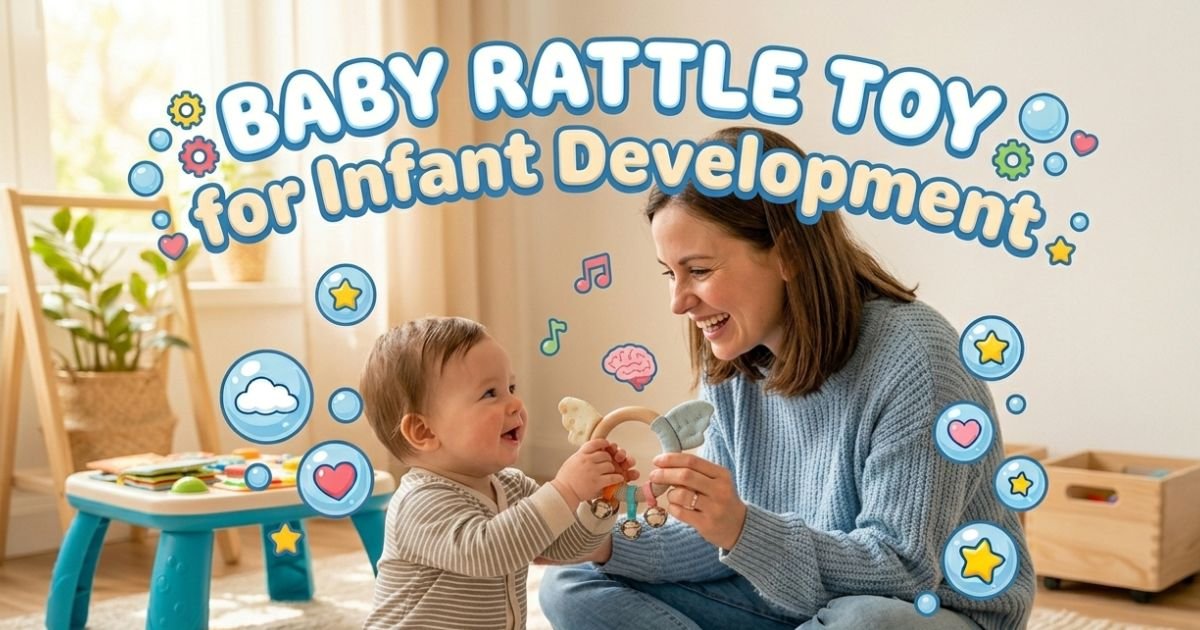

Rattles are more than just cute baby toys a baby rattle toy can be an infant’s first introduction to play and learning. From the moment a newborn sees or hears a rattle, their brain starts connecting sound, sight, and movement. In this guide, we’ll explain what baby rattles are, why they matter for development, and how to choose the best colorful, soft, and educational rattles for your little one. You’ll learn safety tips, developmental benefits, and even step-by-step ways to use rattles in play. By the end, you’ll know exactly what makes a baby rattle toy a must-have in early playtime.
What is a Baby Rattle Toy?
A baby rattle toy is typically a handheld object made for infants (usually 0–18 months) that produces a gentle sound when shaken. It often contains small beads or bells encased inside a grip-friendly handle. Rattles come in many shapes and materials, but their core purpose is to engage a baby’s senses with sound, color, and texture.
By design, a rattle is intended to be easy for tiny hands to hold and shake. Many rattles are colorful or have contrasting patterns, attracting an infant’s visual attention. Some include soft fabrics, silicone elements, or wooden parts to provide varied tactile experiences. In short, a rattle is an infant toy that safely delivers sights, sounds, and sensations to stimulate a baby’s developing brain.
How Baby Rattles Support Infant Development
Far from being mere noise-makers, baby rattles play a crucial role in early development. Health professionals and child experts agree that rattles help babies develop sensory and motor skills. Key benefits include:
- Auditory Skills & Sound Localization: Shaking a rattle gives a baby auditory feedback. Over time, babies learn to locate the source of the sound. Rattles help infants start to turn their heads toward noise, building auditory tracking and spatial awareness.
- Visual Tracking and Hand-Eye Coordination: When a parent or caregiver shakes a bright rattle in front of a baby, the child learns to watch and follow the object with their eyes. This visual tracking practice, combined with reaching to grasp the rattle, strengthens early hand-eye coordination.
- Cause-and-Effect Learning: Every rattle shake teaches cause and effect. An infant quickly realizes, “When I shake this, it makes a noise.” This simple lesson – that actions have outcomes is fundamental to early cognitive development.
- Fine Motor and Grip Strength: Holding and shaking a rattle is actually a workout for tiny muscles. Grasping a rattle, keeping it in hand, and moving it intentionally builds fine motor skills and muscle strength in the wrists and forearms. These skills are precursors to tasks like holding a bottle, feeding with a spoon, or eventually writing.
- Sensory and Tactile Exploration: Rattles often have varied textures (bumpy, soft, ridged) and materials. As babies touch and mouth these surfaces, their brain creates a “tactile map” of sensations. In this way, rattles gently introduce infants to the sense of touch and can even soothe teething discomfort.
- Color and Visual Stimulation: Many rattles come in bright, high-contrast colors. Newborn vision is blurry and sees mostly large contrasts; colorful rattles give just the right visual stimuli. As vision sharpens over the first months, chasing a moving colorful rattle helps babies develop focus and tracking skills.
- Emotional Bonding and Attention: Playing with a rattle is often an interactive, shared activity. Parents shake the rattle and smile, babies babble or giggle in return. This back-and-forth play builds trust and social connection. Rattle play teaches a baby that their caregiver is a source of comfort and fun, laying the groundwork for secure attachment.
Putting it together, experts note that “baby rattles offer a dynamic way to boost an infant’s sensory, motor, and cognitive development”. In fact, pediatric guidelines list rattles as a top toy for infants under 4 months they help babies “build grip and tactile stimulation” and engage their senses. The simple act of grasping and shaking a rattle activates hearing, sight, and touch all at once, giving babies a rich learning experience in every jingle.
Key Benefits at a Glance:
- Builds hand strength and grip as baby holds the rattle.
- Sharpens hearing and auditory skills through sound.
- Teaches cause-and-effect (shake = sound).
- Encourages visual tracking and focus on moving objects.
- Provides tactile and sensory input with different textures.
- Offers emotional comfort and bonding during play.
How to Use a Rattle with Your Baby
Using a baby rattle is easy and fun. Here’s a simple exercise to practice visual tracking and coordination:
Visual Tracking Exercise: Hold a colorful rattle a few inches from your baby’s face while they lie on their back. Gently shake the rattle to catch their attention. Then move the rattle slowly from side to side, maintaining eye contact with your baby. You can follow these steps:
- Choose a safe rattle. Pick a brightly-colored, easy-to-grip rattle appropriate for your baby’s age.
- Position the baby. Lay your baby on their back, ideally on a firm surface or tummy-time mat. Keep the rattle about 8–12 inches from their face so they can see it clearly.
- Shake and move. Give the rattle a gentle shake to grab attention. As your baby looks at it, slowly slide the rattle to one side. Then shake it again as you move it back.
- Encourage following. Pause after each move and see if your baby’s eyes follow the rattle. If they do, smile and keep the movement slow. Repeat the motion back and forth.
- Reward reaching. Over time, your baby will begin to reach for the rattle. Praise them or let them grab it when they do, reinforcing that reaching out leads to a sound reward.
These simple steps help your baby practice hand-eye coordination and tracking. According to infant play therapists, using a rattle in this way “provides an opportunity to practice visual tracking”. Over days and weeks, baby’s eyes and arms will start to coordinate better as they reach to grab the rattle.
Aside from visual exercises, you can incorporate rattles into everyday play:
- Sing and shake. Sing “shake shake shake your rattle” to add rhythm. The music cues baby and creates a multisensory lesson in timing and melody.
- Cause-effect peekaboo. Hide the rattle behind your back, then reveal and shake it. This shows your baby that things still exist even when out of sight (object permanence).
- Free play. Place a rattle on a playmat near baby during floor time. Let them explore it on their own – toddlers love batting at rattles, and every accidental noise is a learning moment.
Each shake and giggle is a tiny lesson. As one expert notes, rattles are much more than entertainment – they “play a vital role in supporting early development” by connecting actions and sounds. By intentionally shaking, offering, and playing with rattles, you give your baby valuable practice with cause-and-effect, coordination, and sensory discovery.
Baby Rattle Toy Safety Guidelines
Safety is the top priority when choosing any infant toy. Rattles are generally safe if they meet toy standards, but there are important rules to follow. U.S. regulations specifically address infant rattles: the Consumer Product Safety Commission (CPSC) requires that rattles stay in one piece and cannot fit entirely into a baby’s mouth. This is to prevent choking or suffocation. In practice, here’s what to check:
- Size and Parts: A rattle should be larger than 1.25 inches (3 cm) in diameter and 2.25 inches (6 cm) long (roughly the size of a toilet paper roll) so it can’t be swallowed. Avoid any rattles with tiny attachments or loose parts like beads, buttons, or ribbons. Ensure it “doesn’t have small parts like eyes, wheels, or buttons that can be pulled loose”.
- Material Safety: Rattles must be made from non-toxic materials. The CPSC specifically bans more than 0.01% lead in any accessible part of a rattle, and limits phthalates in plastics. Look for labels like BPA-free, lead-free, and check that paints or finishes meet toy standards.
- Smooth, Rounded Edges: There should be no sharp points or edges. In fact, regulations forbid any sharp point or edge on rattles. Run your fingers over the toy; it should feel smooth and safe.
- Durability: Babies chew and throw toys! Choose rattles made of sturdy, unbreakable materials. They should withstand biting and tugging. As KidsHealth advises, a baby toy “should be strong enough to withstand chewing”. Regularly inspect the rattle for cracks, loose parts, or worn fabric. Throw it away if it starts to break.
- Strings and Ties: Avoid rattles attached to long strings or cords (like hanging crib rattles) because of strangulation risk. Any fabric or ribbons should be short and firmly sewn. The general rule is no strings longer than 7 inches (18 cm).
- Cleanliness: Rattles spend a lot of time in a baby’s mouth. Pick ones that are washable (machine wash or easy wipe) and clean them frequently. Sanitize according to the manufacturer’s instructions to keep germs at bay.
By following these tips, you’ll ensure the rattle is not only fun but also safe. Remember: If there is any doubt about a toy’s safety, don’t give it to the baby. Always supervise rattle play, especially with very young infants. In summary, a safe baby rattle toy is age-appropriate, large enough not to be swallowed, made of non-toxic material, and free of hazards.
Types of Baby Rattle Toys
Baby rattles come in many forms to suit different ages and preferences. Here are some common types:
-
Plush or Soft Rattles: These are often made of fabric or soft plastic and may include stuffed-animal designs. Soft rattles are gentle for sensitive newborn skin and can double as comfort toys. They usually have easy-to-grab handles and sometimes include teething elements. For example, plush rattles often feature crinkly fabrics and a silicone teething ring on the handle. Because they’re made of cloth or silicone, they’re ideal as a soft baby rattle toy for newborns.
Image: A baby playing with a soft, plush rattle.
Babies under 6 months especially benefit from soft rattles. Plush rattles provide tactile variety (soft fur, rubber teethers) without hard surfaces. Many include sewn ribbons or tags (which babies love to touch) and gentle sounds. For example, the rattle in the image above has a cuddly plush body and a gentle jingle inside. These soft rattles are easy for tiny hands to hold and are safer for babies who put everything in their mouths.
-
Colorful Rattles: Bright colors and interesting shapes make these rattles visually engaging. High contrast patterns (black/white, or bold color combos) are especially good for newborns whose vision is still developing. A colorful baby rattle toy often features a mix of vivid colors (red, blue, green, yellow) and patterns. This visual stimulation is important: experts note that “bright, bold colors are so important in early toys” because they help support visual development. As babies grow, a moving colorful rattle becomes a “moving target to track,” which enhances their focus.
Image: A set of colorful rattles and teether toys, which engage a baby’s visual attention.
(Above: A bright, multicolor rattle and teether set. Colorful toys like these stimulate early visual and cognitive skills.)
-
Wooden or Natural Rattles: Often designed in simple shapes (rings, balls, animals) with no paint or with food-safe finishes. Wooden rattles (sometimes with silicone rings) are popular in Montessori toy sets for their natural look and feel. They tend to have gentle sounds (like wood on wood) and are sturdy. Because they don’t contain plastic, some parents prefer them as long as they’re well-made. The gentle “clack” of wood can be soothing. Wooden ring rattles also teach shape and cause-effect very naturally.
-
Silicone and Teething Rattles: These rattles are made from food-grade silicone or rubber. They often combine a hard ring handle with a textured silicone section for chewing. These are great when baby starts teething, as the silicone is soft on the gums. Some have beads or holes so baby can grip easily. Often advertised as “teether rattles,” they fulfill two roles. They are typically brightly colored and light to shake, providing sensory stimulation while also giving relief during teething.
-
Wrist or Foot Rattles: These are special rattles that strap onto a baby’s wrist or ankle (usually with Velcro). When the baby wiggles arms or legs, the rattle jingles. These can encourage movement and self-awareness. However, always ensure they have quick-release straps for safety and supervise to prevent twisting on limbs.
-
Educational Rattles: Some rattles double as first learning toys. For example, a rattle shaped like a small phone with numbers, or blocks rattles with letters, can introduce colors, shapes, or letters. These educational baby rattle toys still follow basic safety rules, but their designs encourage early learning concepts. The constant sound-reward loop also reinforces the idea of cause and effect, an early cognitive skill. (For instance, a rattle shaped like an animal might have the letter “A” on it, or a musical rattle might play a simple tune when shaken.)
-
Rattle Toy Sets: Instead of one rattle, many manufacturers sell sets of multiple rattles. A baby rattle toy set might include a variety of shapes (rings, balls, animal figures) and materials (plastic, wood, silicone). These sets allow the baby to experience different sizes, textures, and sounds. They are often marketed for “all stages” for example, a set might contain 0-3 month soft rattles, 3-6 month plastic rings, etc. A set can be a convenient starter kit or gift, giving caregivers several options without buying individually. When buying a set, just check each piece meets safety standards.
Each type of rattle supports development in its own way. The common thread is that they all invite your baby to explore with their senses. In the next section, we’ll cover how to pick the best baby rattle toy among these types.
How to Choose the Best Baby Rattle Toy
With so many options, how do you pick the best rattle for your baby? Here are some practical tips:
- Age Appropriateness: Look at the manufacturer’s age range. Very small rattles are not safe for newborns, and some rattles that light up or make complex sounds may be too advanced for under-6-month-olds. A rule of thumb: simple, soft rattles for 0–3 months, and more complex/interactive rattles (with buttons, music, lights) for 6+ months.
- Ease of Grasp: For infants learning to hold objects, choose rattles with easy grips. Many top rattles have multiple large loops or handles. In fact, rattles with several ways to hold help babies build grip strength. Try to find rattles that a baby can hold in different ways (ring-shaped, bar-shaped, loop-shaped).
- Material & Cleanliness: BPA-free and non-toxic plastics, or FDA-grade silicone, are best. Check labels for “BPA-free,” “phthalate-free,” and conformity to ASTM or EN-71 toy safety standards. Also consider cleaning: washable plush rattles and plastic toys that can be wiped are ideal since rattles will get drooled on and chewed. One blogger emphasizes choosing rattles that are easy to wash to maintain hygiene.
- Engaging Sounds: The sound of the rattle should be pleasant and not too loud or shrill. Usually, soft jingles or gentle bells are best. Some rattles have multiple sounds (like crinkle fabric plus a bell), which can keep baby interested. Be wary of rattles with electronics or very loud noise babies have sensitive hearing.
- No Loose Parts: Inspect that the noisemaking pieces (beads, bells) are well-sealed inside. If the rattle has movable parts, they should be large enough not to choke. A “good set” of rattles includes different shapes and textures but still ensures no small parts come loose.
- Washable: As mentioned, anything baby mouths needs regular cleaning. Removable covers or machine-washable toys are convenient. If the label says “surface wash only,” have cleaning wipes handy.
- Durability: Babies throw toys. The best rattles are those that don’t break when dropped. Reading reviews can help; brands like Manhattan Toy, Fisher-Price, or Melissa & Doug have reputation for durable rattles.
- Learning Elements (optional): If you want an educational rattle, look for ones that incorporate learning: shapes, letters, or simple cause/effect games. For example, some rattles might have numbered beads inside or voice buttons. These are not necessary for very young infants, but can be a bonus as baby grows. Ensure any added features still meet safety (no loose buttons or choking hazards).
- Softness for Teethers: If your baby is teething, consider soft baby rattle toys with silicone or rubber parts. These can be safer and more comforting than hard plastic when teeth begin to come in.
In essence, the best baby rattle toy is the one that fits your baby’s stage and needs: it should be safe, easy to handle, and engaging. Safety certification (look for the ASTM or CE marks) is a must. Comfort for baby (no harsh edges, non-toxic materials) is key. And of course, it should be fun and capture your baby’s interest. As Tumama Kids advises, always select rattles “without small detachable parts, sharp edges, or hazardous materials” and keep them clean.
Tips and Considerations
- Rotate Toys: Even with just a few rattles, rotate them. Giving the baby a “new” toy even after a few days can renew interest and engagement.
- Use During Supervised Tummy Time: Placing a colorful rattle just out of reach can encourage a tummy-time baby to reach forward, strengthening neck and arm muscles.
- Attachable Rattles: Some rattles clip onto car seats or strollers. These can be handy on-the-go, but double-check the clip is secure and doesn’t dangle loosely.
- DIY Option: If you’re crafty, you can make homemade rattles (for example, by sealing safe beads inside a sturdy plastic egg or bottle). Just follow the same safety rules – no small parts and fully sealed. Always supervise and dispose if it starts to break.
- Budget vs. Splurge: Rattles range from very cheap (a small plastic one from a dollar store) to more expensive designer toys. Price isn’t always quality. Many simple, inexpensive rattles (like a classic wooden ring or a plastic bar with beads) do the job wonderfully. If budget allows, investing in one or two high-quality rattles can be nice, but even DIY or toy-store options can be effective developmental tools.
Conclusion
A baby rattle toy may be small and simple, but it packs a big developmental punch. From promoting auditory and visual skills to strengthening little hands and teaching cause-and-effect, rattles are ideal first toys that grow with your baby. When choosing rattles, focus on safety (no small parts, non-toxic materials), age-appropriateness, and sensory appeal (soft textures, pleasant sounds, bright colors).
Introducing a rattle into your baby’s playtime is easy just shake it in front of them or let them grasp it. Remember to supervise, keep rattles clean, and enjoy the giggles and curiosity they bring. As you do, you’ll be giving your infant a head start in motor skills, sensory learning, and cognitive development, one shake at a time.
Ready to pick the perfect rattle? Look for ones that combine safety with fun: a colorful, soft, educational baby rattle toy that matches your child’s age and interests. Whether it’s a plush animal that rattles, a set of Montessori wooden rings, or a classic plastic bar with beads, the right rattle can support your baby’s growth while bringing smiles to playtime.
