
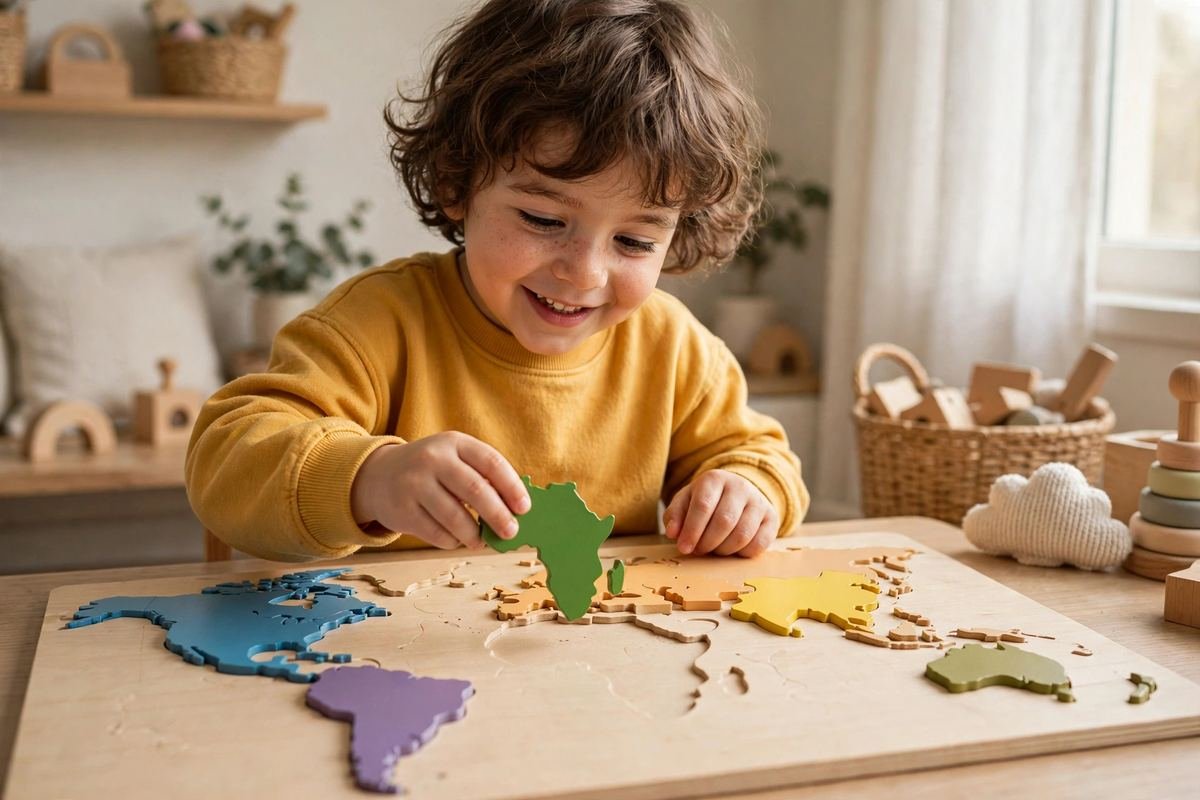
Preschoolers are natural explorers. They want to know where Grandma lives, where the plane went, and why it is night somewhere else. The best geography toys for preschoolers turn those big questions into something small hands can spin, piece together and point at. A first globe or map puzzle will not make your four year old a geography expert, but it plants a wonderful idea early: the world is wide, varied and worth wondering about.
Start simple. One continent, one ocean and one faraway animal is plenty for a first session. Geography toys for preschoolers work best when you follow your child curiosity, finding your own country, tracing a trip, or hunting for where penguins live. This guide gathers chunky puzzle globes, floor puzzles, a talking globe and solar system sets from trusted makers, each one chosen for preschool hands and preschool attention spans.
You will find the best world map puzzle for kids who love jigsaws, globe toys for preschoolers who love to spin things, and space sets for children who keep looking up. Browse our homepage later for more learning ideas, and let us start with the fastest picks. Every product below is real, well known and suited to learning through play rather than lessons.
Quick Picks: Geography Toys for Preschoolers at a Glance
For a first geography toy, the Learning Resources Puzzle Globe is our top choice, because each continent lifts out like a chunky puzzle piece. The VTech Light and Flight Discovery Globe suits children who love buttons, lights and airplane sounds, and it works well as an educational globe for 4 year olds. The GeoToys GeoPuzzle World builds the map piece by country shaped piece. For space fans, the Hape Solar System Puzzle starts the journey beyond Earth.
- Best first globe: Learning Resources Puzzle Globe
- Best interactive globe: Shifu Orboot Earth
- Best world map puzzle: GeoToys GeoPuzzle World
- Best solar system set: Hape Solar System Puzzle
- Best for 4 year olds: VTech Light and Flight Discovery Globe
How to Choose Geography Toys for Preschoolers
Think about how your child likes to learn. Puzzle lovers need maps that come apart and go back together. Spinners and button pressers light up with a talking globe. Children who love stories do best with maps full of animals, landmarks and pictures to talk about. Our educational and learning toys collection can help you match the style to your child.
Start With Continents, Not Countries
Young children grasp big shapes first. Seven continents and five oceans are a friendly starting map, while country borders can wait. A continent puzzle for montessori style shelves follows this idea, with each land mass as one smooth piece your child can trace, lift and name. Once continents feel familiar, add a map with countries, flags or animals, and watch the questions get wonderfully specific.
Choose the Right Format: Globe, Puzzle or Floor Map
A globe teaches the truth that Earth is round and always spinning, which flat maps cannot show. Map learning toys for toddlers and preschoolers, like chunky floor puzzles, suit children who learn on the carpet with their whole bodies. Wall maps and floor mats give a big picture for spotting oceans. Many families start with one globe and one puzzle, because the two formats answer different questions during play.
Look Beyond the Map to Space
Geography often opens the door to the solar system. Solar system toys for young kids, like wooden planet puzzles and big floor puzzles, teach order, size and the idea that Earth is one planet among many. If your preschooler asks about the moon and stars, a planet puzzle beside the globe makes a lovely learning corner. The best geography toys for preschoolers grow this way, from home town to whole planet to the space around it.
The 10 Best Geography Toys for Preschoolers
1. Learning Resources Puzzle Globe
This clever globe splits the difference between a globe and a puzzle. Each continent is a chunky piece that lifts out of the spinning base, and the oceans stay printed on the sphere beneath. Preschoolers can remove a continent, name it, spin the globe and slot it home again. Labels name the continents and oceans in clear words. For a first geography toy, the hands on design teaches the shape of the world better than any lecture.
- Removable continent pieces on a spinning globe
- Clear labels for continents and oceans
- Chunky pieces sized for preschool hands
- Sturdy base made for classroom and home
Pros: The puzzle design invites touching, naming and repeating, which is how preschoolers learn. Cons: Countries are not shown, so older children will need a more detailed globe later. It suits three to five year olds meeting the world map for the first time, especially hands on learners who love puzzles.
2. VTech Light and Flight Discovery Globe
This globe talks, lights up and flies your child around the world. A small joystick moves a pretend plane, and pressing places on the globe plays facts, animal sounds and greetings from around the world. Continents, oceans, and famous landmarks appear through games and songs that keep sessions lively. The content suits preschoolers well, with simple facts and lots of repetition, and the spinning globe keeps hands busy between questions. The globe is light enough for a preschooler to carry from room to room.
- Interactive globe with joystick and plane
- Facts, greetings and animal sounds
- Games and songs about continents and landmarks
- Light up design that holds attention
Pros: The game style keeps curious children playing longer, and the facts are well pitched for the age. Cons: It needs batteries and the sounds are lively for quiet rooms. It suits button loving preschoolers and families shortlisting geography toys for preschoolers that talk, quiz and sing.
3. Melissa & Doug World Map Floor Puzzle
This giant floor puzzle spreads the whole world across the carpet. Forty eight chunky pieces show the continents, oceans and friendly pictures of animals and landmarks from each region. The pieces are thick, the finished puzzle is big enough to sit beside, and the artwork gives you dozens of things to point at and name together. Floor puzzles suit preschoolers who think best while moving, crawling and building on the ground. The box shows the finished picture, which helps younger children know where to begin.
- Forty eight chunky floor puzzle pieces
- Animals and landmarks pictured by region
- Extra thick pieces that wipe clean
- Large finished size for floor play
Pros: The scale makes geography a whole body activity, and siblings can build it together. Cons: It needs a clear floor space and a box to keep pieces together. It suits active preschoolers, playrooms and classrooms where big cooperative puzzles get plenty of use.
4. GeoToys GeoPuzzle World
The GeoPuzzle takes a clever idea and runs with it: the pieces are shaped like real countries and groups of countries. Building the world means learning the true shapes and neighbors of each land as you play. The puzzle is sturdy, the colors are clear, and the finished map rewards close looking. It is a step up in detail from continent puzzles, which makes it a satisfying next challenge for older preschoolers and kindergartners. Building it again and again quietly forms a mental map that later atlases build on.
- Pieces shaped like real countries
- Teaches shapes, neighbors and capitals gradually
- Sturdy pieces made for repeated builds
- Detailed world map when complete
Pros: Learning country shapes by hand is powerful, and the puzzle grows with your child. Cons: Smaller country pieces are fiddly for three year olds. It suits older preschoolers ready for detail, and families comparing geography toys for preschoolers that will still challenge a six year old.
5. Shifu Orboot Earth
Orboot is a globe that comes alive through a tablet or phone app. Your child spins the plain globe, points the device at a region, and watches animals, foods, monuments and cultures appear in augmented reality with spoken facts. Categories like animals, cultures and inventions give the exploration a structure that curious preschoolers enjoy. It is the most high tech pick here, and for screen confident families it can feel like carrying the whole world in one ball. Simple extras in the box extend the exploring beyond the screen as well.
- App based globe with augmented reality
- Animals, cultures, food and monuments
- Spoken facts that suit pre readers
- No borders printed, so the globe stays clean
Pros: The content is deep and beautifully presented, and updates keep it fresh. Cons: It needs a compatible device and an adult nearby for the app. It suits tech happy families and curious four and five year olds who ask endless questions about faraway places.
6. Hape Solar System Puzzle
This wooden puzzle lifts geography into space. Chunky planet pieces sit in a round board painted with the sun at the center, and each planet shows its color and character. A printed guide on the board helps children place the planets in order, and the solid wood pieces suit small hands. It is a natural partner to a globe, answering the next big question: where does our planet live, and who are its neighbors? The chunky pieces press in and lift out easily, so the puzzle works again and again.
- Chunky wooden planet pieces
- Sun centered board with placement guides
- Bright planet colors and clear order
- Smooth wood made for small hands
Pros: The chunky build suits young preschoolers, and the order of the planets sticks through play. Cons: It teaches order and names rather than facts about each planet. It suits space curious three and four year olds starting with the planets before deeper space toys.
7. Melissa & Doug Solar System Floor Puzzle
This big floor puzzle shows the planets in rich color across a wide space scene. Forty eight pieces build a picture with labels for the planets, which gives you plenty to talk about while you build. The scale suits floor play with siblings, and the sturdy cardboard survives repeated builds. Paired with a globe on the shelf, it completes a small world and space corner that preschoolers return to often. The pieces are big enough for two children to build the same scene together. It stores flat in its box between space sessions.
- Forty eight piece floor puzzle
- Labeled planets in a rich space scene
- Extra thick, wipe clean pieces
- Large size for group building
Pros: The picture is beautiful and the labels support early reading. Cons: Space facts are limited to names and order. It suits puzzle loving preschoolers and families building a set of geography toys for preschoolers that reaches from continents to planets.
8. LeapFrog Magic Adventures Globe
This talking globe uses a stylus to explore thousands of facts. Children tap continents, countries, animals and landmarks to hear videos and facts gathered with the BBC, covering animals, cultures and geography. Quiz modes test memory as skills grow, so the globe suits children from preschool into early school years. The built in screen shows short videos, which makes faraway places feel real and alive for young explorers. The globe sits at a good height for table play and shared question time. It also keeps well on a study desk as children grow.
- Stylus activated talking globe
- Thousands of facts and short videos
- Quiz modes that grow with your child
- Animals, cultures and landmarks covered
Pros: The fact library is huge, and the videos hold attention beautifully. Cons: It sits at a higher price and suits the older end of preschool best. It suits question driven four and five year olds who are ready for real facts, maps and quizzes.
9. Janod World Map Puzzle
Janod brings French style to the world map with this boxed puzzle. The artwork is gentle and detailed, with animals and scenes that invite slow looking and talking. The pieces are sturdy cardboard, and the finished map looks lovely enough to hang in a playroom. It teaches patience as much as geography, because the piece count makes it a longer project that preschoolers can build with a grown up over a weekend. The sturdy box stores the pieces safely between those family building sessions. A picture of the finished map on the box helps new builders too.
- Detailed world map artwork
- Animals and scenes from each region
- Sturdy pieces in a storage box
- Finished map suits playroom display
Pros: The picture rewards close looking, and building it together makes a lovely family project. Cons: The piece count is a challenge for younger preschoolers. It suits older preschoolers who enjoy longer puzzles and families shortlisting geography toys for preschoolers with beautiful artwork.
10. Crocodile Creek World Map Floor Puzzle
Crocodile Creek is known for rich, playful puzzle art, and this world map floor puzzle shows why. Big, sturdy pieces build a colorful world filled with animals in their home regions. The finished puzzle is large, the pieces are thick enough for preschool hands, and the storage box has a handle for taking the puzzle visiting. It is a friendly first world puzzle for children who learn animals first and maps second. Bold outlines help young children see each continent as its own friendly place. It is a happy first step into map play.
- Large floor puzzle with regional animals
- Thick pieces for preschool hands
- Colorful, detailed artwork
- Storage box with a carry handle
Pros: The animal theme hooks young children, and the build quality is excellent. Cons: Political detail is light, as it should be at this age. It suits animal loving three to five year olds and families who want a cheerful, durable first map puzzle.
Safety and Care
Geography toys for preschoolers are gentle toys, but puzzle pieces and globe stands still deserve a quick safety routine. Check age guides before buying, because sets with small country pieces can be a choking risk for children under three. The U.S. Consumer Product Safety Commission explains small part risks for young children at cpsc.gov, and the advice is worth reading before a detailed puzzle set arrives.
Store puzzles in their boxes with a quick piece count at tidy up time, and keep missing piece sets out of rotation until they are complete. Wipe floor puzzle pieces with a damp cloth after carpet play, and let talking globes dry fully if a drink spills nearby. Keep globes on low, stable shelves where small hands can spin them safely without pulling them down from a height.
Frequently Asked Questions
What geography should a preschooler learn first?
Start with where your child lives, then your country, then the continents and oceans. Landmarks, animals and foods from each place make the learning stick far better than names alone. Keep it playful, follow questions, and revisit the same globe or puzzle often. Repetition during play is what turns a shape into real knowledge.
Is a globe or a map better for a 4 year old?
Both teach different truths. A globe shows that Earth is round and where places sit in relation to each other, while a map puzzle builds detail and memory through the hands. Many families use geography toys for preschoolers in pairs, one globe for spinning and one map for building, and an educational globe for 4 year olds often becomes the most touched toy on the shelf.
How do I make geography play part of our week?
Link the toys to real life. Find the country when a story mentions it, trace a family trip on the globe, or pick an animal of the week and find its home. Short, regular moments beat rare long lessons. A globe near the dining table starts more good talks than almost any other learning toy.
Are solar system toys part of geography?
They are the natural next step. Once a child understands that Earth is a planet with continents and oceans, planets and space become the bigger map. Planet puzzles teach order and scale in the same hands on way. Many children move between the globe and the solar system puzzle in a single play session.
What are the best geography games for older preschoolers?
Look for memory games with flags or landmarks, simple card games about animals of the world, and quiz modes on talking globes. Geography learning games for kids work best when they grow from the maps your child already knows. The geography toys for preschoolers on this list pair well with story atlases and animal books as reading skills grow.
Conclusion
A first globe or map puzzle gives your child a lifelong gift: the feeling that the world is knowable and interesting. Start with the geography toys for preschoolers that match how your child plays today, spin and build often, and let questions lead the way. For more early learning ideas, explore our blog and our baby learning toy guide, then enjoy the dinner table talks that follow.
