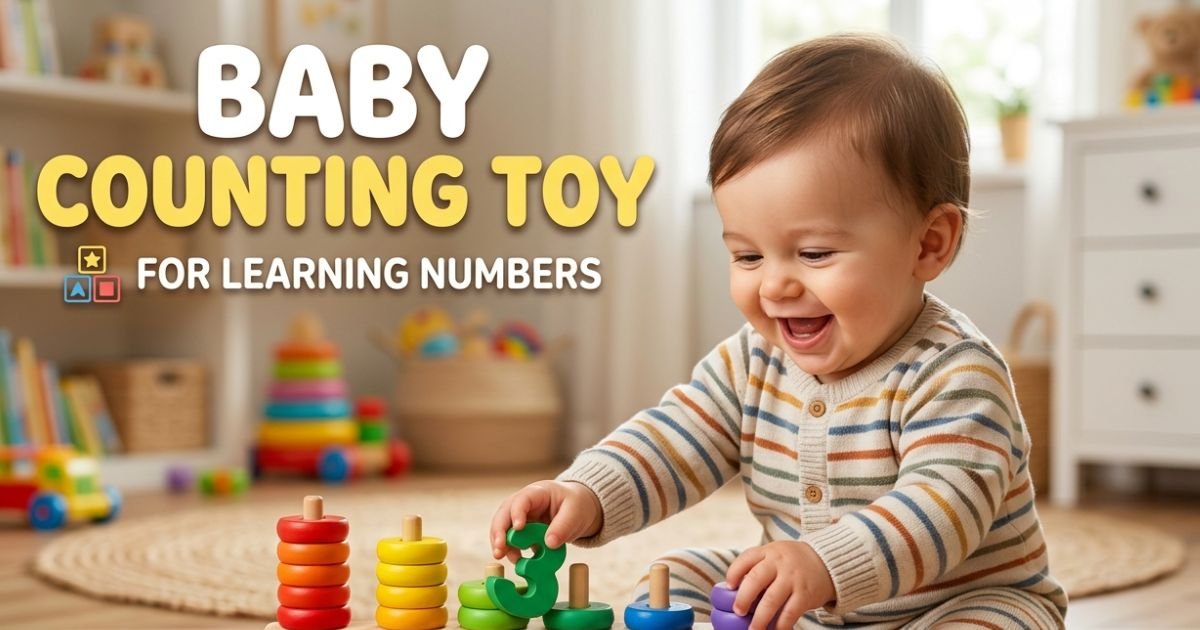

Learning to count is a key milestone in early childhood, and a baby counting toy can make that journey fun and engaging. In this comprehensive guide, we’ll explain why counting toys matter, explore different types of counting toys (from wooden abacuses to interactive games), suggest fun counting activities, and offer tips on choosing the best counting toy for your little one. Babies and toddlers start picking up number skills long before they enter school. In fact, children start learning numeracy skills from birth, and simple games like comparing big vs. small or grouping objects introduce basic math concepts. For example, describing how one toy is big and another is small or counting two blocks during play teaches these early number ideas naturally.
A baby counting toy is any toy designed to introduce numbers and counting in an age-appropriate way. This might be a wooden abacus with colorful beads, a number puzzle with pieces for 1–10, a counting board, or an interactive gadget that chants numbers or plays number songs. When babies move beads, fit numbered pieces, or press buttons to hear a number, they connect number words with real quantities. These playful experiences lay the foundation for math understanding. Research shows that infants and toddlers are naturally curious about quantities – they notice if one child has two crackers and another only one, foreshadowing later counting skills. By giving children educational baby counting toys, parents help turn everyday play into early numeracy practice.
Benefits of Baby Counting Toys
Counting toys are more than just playthings – they bring big developmental gains. By turning numbers into hands-on play, counting toys help children build math skills intuitively. Key benefits include:
- Early Number Sense: Counting toys link number names to concrete items. As a child slides beads on an abacus or places toy fruits into a basket one by one, they learn that the word three means “three of something.” This hands-on learning helps toddlers grasp one-to-one correspondence (each count stands for one object) and eventually the idea of cardinality (the last number counted is the total quantity).
- Quantity Concepts: Beyond reciting, children learn how many. They practice counting exactly how many items are present. Toddlers might line up blocks and point to each as they say “one, two, three,” linking each number to an object. Over time they understand that “three” means three objects, which is crucial for later arithmetic.
- Fine Motor Skills: Manipulating counting toys builds coordination. Turning pegs, fitting puzzle pieces, or sliding beads requires careful hand-eye control. For example, moving wooden rings on an abacus or pressing numbered buttons exercises finger strength and dexterity.
- Language Development: Counting introduces new vocabulary. Children learn number words (“one,” “two,” “more,” “less,” etc.) as well as related terms like before, after, big, and small. Singing counting songs (e.g. “Five Little Ducks” or “Ten in the Bed”) combines numbers with rhythm and rhyme, making it easier for babies to remember the sequence of numbers.
- Cognitive Skills: Count-based play trains memory, attention, and logic. To count objects correctly, kids must remember which numbers have been said and focus on the task. This problem-solving aspect figuring out how many objects there are boosts critical thinking. Research notes that counting helps develop problem-solving and spatial awareness as toddlers compare quantities and positions.
- Spatial Awareness: Many counting activities involve comparing sizes and positions. Building with counting blocks or matching shapes teaches concepts like big vs. small, taller vs. shorter, over vs. under. These spatial skills are part of early numeracy. For instance, stacking rings from largest to smallest while counting introduces both the order of numbers and the idea of size differences.
- Real-World Skills: Counting is used in everyday tasks like telling time, cooking, and using money. Early counting practice prepares children for these life skills. As Skoolzy notes, preschool counting skills eventually help kids figure out concepts like how long to wait, how many coins they have, or how to measure ingredients. Starting with counting toys means they build this understanding through enjoyable play.
- Confidence and Fun: Combining play with learning makes children enthusiastic about numbers. Each counting toy success (sliding the last bead, stacking all rings, solving a puzzle) gives a sense of achievement. Learning through play keeps it pressure-free so kids develop a positive attitude toward math.
Hands-on play with blocks or other toys helps babies develop counting skills. For instance, stacking and counting each block in a tower lets toddlers practice one-to-one correspondence (matching one number word to one object) while also building fine motor skills. Activities like these make counting feel like play, which keeps little ones engaged and excited to learn more.
Types of Baby Counting Toys
Counting toys come in many forms. Here are popular types:
-
Wooden Counting Toys: Traditional wooden toys are durable and sensory-rich. A wooden abacus with colored beads lets a child slide beads along rods to count by sight and touch. Wooden number puzzles (with pieces shaped like numerals) or counting blocks often have the numbers 1–10 on them, so toddlers match the symbol with that many objects. Wooden toys tend to be safe for babies to handle and often have smooth, natural finishes. The tactile experience of moving smooth wooden beads and fitting pieces engages multiple senses, reinforcing learning.
Wooden counting toys are traditional favorites. This Montessori-style counting abacus (above) combines colored beads with number tiles, so a child can match rings to numerals. Each slide of a bead reinforces counting. Many parents like these wooden toys because they’re sturdy, eco-friendly, and free from distracting lights or sounds. Moving the beads also strengthens fine motor skills and concentration in toddlers.
-
Interactive/Electronic Counting Toys: Some toys add lights, sounds, or motion to enhance play. For example, a shape-sorter toy might announce “three” when a child inserts the third block, or a talking number book might sing number rhymes. These features can excite babies and toddlers, making counting more engaging. However, look for toys that still focus on manual play (buttons to press, flaps to lift) rather than screens. Many interactive toys have simple “on/off” modes and volume controls to keep playtime calm. For instance, a VTech or Fisher-Price toy might sing a counting song when a number button is pressed. When chosen carefully, electronic counting toys combine fun sounds with learning – but they work best alongside hands-on toys.
-
Stacking and Sorting Toys: Many counting toys involve stacking rings, nesting cups, or sorting sets. Numbered stacking rings (each ring labeled 1–10) encourage kids to count each ring as they stack it. Nesting cups often have numbers and allow toddlers to count them as they stack or nest them. Sorting toys, like sets of colored counting bears with matching cups, let kids sort by color or size and count each group. These activities blend counting with matching skills. For example, you might say “Let’s sort these pom-poms into baskets and count how many red ones go in the red basket” – turning sorting into a counting game.
-
Counting Boards and Puzzles: Some educational toys are puzzle-like boards with counting features. For example, a Montessori counting board has a built-in addition strip and beads. A toddler might slide beads to match a simple sum (e.g. “1 + 3 = 4”). As the child moves each bead, they are literally solving a math problem in a concrete way. These hands-on counting boards teach sequencing and the concept of addition visually. After sliding the beads, the child sees that the total matches the last number counted, reinforcing number relationships.
Counting boards and puzzles combine play with math challenges. In this Montessori-style board (above), toddlers slide beads to match a simple sum. For example, to solve “1 + 3 = 4,” the child slides one bead under “1,” three beads under “3,” and sees that there are four beads total. This visual, hands-on approach makes abstract numbers concrete. It helps children understand that the final count (“4”) represents the total quantity.
-
Counting Games and Books: Simple games and story books can also teach counting. Board games with number spaces or dice require children to count moves. For example, rolling a die and moving a token 3 spaces involves counting from 1 to 3. Counting puzzles (like jigsaws with numbers and dot patterns) let kids match a number piece to a group of objects. Counting books invite children to count animals or shapes on each page. These tools add a narrative or social element to counting practice.
-
Educational Baby Counting Toys: Some products are explicitly labeled as counting or math toys for little ones. These might include crinkle counting books (where you count animals on each page), shape-sorting cubes with numbers, or snack-counting pretend sets. The key is they clearly focus on numbers – for example, teaching “how many” through play food or linking blocks. Brands often describe these as “STEM toys” or “learning toys” that build early math skills.
Baby Counting Toy Activities
Counting toys are most effective when paired with fun activities. Here are ideas for using counting toys in play:
- Count Everyday Objects: Make counting part of daily life. Count toys as you put them away, steps as you climb stairs, or peas on a plate. For example, ask “How many apples are in the bowl?” and have your child count each one. The Victorian education department suggests counting pieces of fruit, cutlery, or houses on a walk during routine tasks.
- Sing and Play: Incorporate counting songs and finger plays into playtime. Classics like “Five Little Ducks” or “One, Two, Buckle My Shoe” use counting in a catchy way. Wiggle your fingers or toes while you count them. The combination of music, words, and actions helps children internalize the number sequence.
- Sorting and Matching: Use the counting toy’s pieces for sorting games. If you have colored counting bears, sort them by color and then count each pile. Matching numeral cards with a set of objects (e.g., matching “4” to four blocks) is another great game. Sorting and counting together reinforces multiple concepts at once.
- Puzzle Play: Utilize number puzzles or count-by matching games. Many toys have pieces shaped like numbers or pictures of items. For instance, a puzzle might have the piece “5” fit into a slot with five stars. As your child places it, count the stars together. This helps connect the numeral with the quantity.
- Clean-Up Counting: Turn tidying up into counting practice. Challenge your child to put away toys by counting them: “How many cars can you put in the box? 1… 2… 3!” This immediately reinforces counting within a familiar activity.
- Hide-and-Seek Numbers: Hide foam or magnetic numbers around the room. When your child finds one, say its number together. For older toddlers, hide numbers in sequence (find 1, then 2, then 3). This adds movement and excitement to number play.
- Shopping and Cooking: Pretend-play store or kitchen. Label play food with prices and use play money to buy them. Counting coins and bills teaches that numbers have value. The Victorian guide suggests such shop games – parents can write numbers on sticky notes (e.g. 2 cents, 5 cents) and count money during checkout.
- Board Games and Dice: Simple board games involve rolling dice and counting moves. Each turn, the child rolls a die and counts the dots to move that many spaces. This practice ties counting to a physical action and turn-taking. Over time, many children begin to recognize die patterns without counting each dot.
Try to keep these activities light and playful. Even ordinary routines like bathtime (counting rubber duckies) or bedtime (counting sheep in a story) can be counting sessions. As JoyCat emphasizes, consistency and repetition make counting stick: linking number words to real objects repeatedly helps babies learn.
How to Choose the Best Baby Counting Toy
With so many options, finding the right counting toy can be tricky. Here are tips to choose a high-quality, age-appropriate toy:
- Safety: Check age recommendations and ensure no small parts could be a choking hazard. For babies, pieces should be large and non-toxic. Avoid toys with sharp edges or loose parts. JoyCat specifically advises looking for “non-toxic materials and [to] avoid small parts” in counting toys.
- Durability: Babies and toddlers put everything in their mouths and drop toys often. Choose materials that withstand this abuse. Wooden or thick plastic toys usually last longer. Durable construction means the toy can survive rough play and still teach.
- Engaging Design: Look for bright colors, interesting shapes, and (if suitable) sounds or textures. Engaging visuals and tactile features capture a toddler’s attention. For instance, toys with moving parts, knobs, or peek-a-boo flaps invite exploration. JoyCat notes that “bright colors, interesting textures, and interactive elements help hold attention”.
- Clear Counting Focus: The toy should clearly emphasize numbers. Good counting toys have numbers printed or molded on them, or come with counting cards. This way, the child knows the goal is to learn numbers. A toy that builds, sorts, and explicitly involves counting (rather than a generic toy) is most effective.
- Versatility: The best counting toys offer multiple ways to play. For example, a set of beads can be used for counting, sorting by color, or making patterns. A toy that “grows” with your child will get more use. JoyCat points out that pieces supporting counting, sorting, and pretend play “grow with your child and get used more often”.
- Educational Value: Read descriptions or reviews to ensure the toy is meant to teach counting. Manufacturers often mention “one-to-one correspondence,” “number recognition,” or “STEM learning.” Choose toys explicitly designed for early math (e.g., Montessori counting sets, learn-to-count games).
- Appropriate Size: Make sure the toy’s pieces are suitable for your child’s age. Under 1 year old usually means very chunky pieces, while a 2-year-old can manage smaller parts. The pieces should not be a choking risk.
- Budget and Quality: Expensive isn’t always better, but extremely cheap toys may break. Investing in a well-made counting toy can pay off if it lasts and keeps your child’s interest.
Expert Tips for Parents
To make counting toys most effective, try these expert tips:
- Play Together: Children learn best with an involved adult. As Dr. Chris Drew notes, “Your child won’t learn without support and guidance… use language a lot,” saying “one” when your child picks up the first block. Sit with your child and count aloud as they play. Comment on what you see (“You have two blocks in your hand!”) and ask questions (“How many cars do you have now?”). Your enthusiasm and guidance turn playtime into learning time.
- Use Math Language: Incorporate counting words and concepts into everyday talk. Describe what you do: “I’m giving you one banana, now two, now three.” Talk about sizes and positions (“big bowl,” “small spoon,” “over the fence,” “under the chair”). Hearing this math vocabulary at home builds a strong foundation. Research shows that exposure to rich math language predicts better number skills later.
- Be Patient and Positive: Learning numbers is a process. Praise all efforts (“Great counting!” even if they skip a number). If your child loses interest, move on and try again later. Keep sessions short (a few minutes) and fun. Make counting part of a game or song. The goal is practice, not perfection.
- Follow Their Lead: Notice what fascinates your child. If they love bouncing balls, count bounces. If they enjoy puzzles, count puzzle pieces. Align activities with their interests to keep them engaged. Gradually offer more challenge (counting higher, adding/subtracting) as they master a level.
- Integrate Into Routines: Use every chance to count. Sing a counting song at bath time, count socks as you dress in the morning, or count trees on a walk. The Victorian numeracy guide encourages counting during meals, shopping, and chores. These natural moments make math a normal part of life.
- Combine Skills: Counting toys can teach other concepts too. Practice counting while naming colors (“3 red blocks”) or shapes (“2 squares”). This links numbers with other learning areas. For older toddlers, simple addition (“If we take 2 blocks from 5, how many are left?”) introduces arithmetic organically.
- Adapt and Upgrade: Finally, adjust as your child grows. If a toy becomes too easy or boring, move to the next level. For instance, start by counting objects one at a time, then ask your child to skip-count (e.g. by twos) or count backwards. Always make sure the challenge is fun, not frustrating.
Conclusion
Baby counting toys turn early math learning into playtime, giving children a strong foundation in numbers and logic. By moving beads, stacking blocks, or pressing number buttons, babies and toddlers build number sense, language, and motor skills in one go. The benefits last: research indicates that by age 5, most children can recite numbers up to 20 and understand that the last number counted is the total (the “cardinal principle”). Starting counting practice in infancy helps little learners reach these milestones naturally.
Whether you choose a classic wooden abacus, a colorful puzzle, or an interactive counting game, the most important ingredient is interaction count along, ask questions, and celebrate every correct count. Start small (count to three or five), make it fun, and build up gradually. Soon your child will proudly say “one, two, three!” all on their own.
Embrace these moments and watch your child fall in love with learning. With the right counting toy and a dose of creativity, you’ll turn ordinary play into extraordinary learning. Count today, and you’ll be counting on a bright future for your little one!
