
What Is a Baby STEM Toy?
“STEM” stands for Science, Technology, Engineering, and Mathematics. A baby STEM toy is any toy that encourages learning and exploration in these areas through interactive play. Rather than drilling facts, STEM toys are designed for play-based learning – they get little ones to build, stack, sort, and experiment while naturally encountering math and science concepts.
For example, a stacker set or shape sorter fosters engineering and math thinking, while simple sensory toys (like colored blocks or water pipes) spark cause-and-effect discovery. According to early learning experts, STEM learning “does not begin with worksheets” but starts with play when children manipulate objects and make sense of the world in a hands-on way. In other words, babies are natural engineers and problem solvers from birth.
Typical categories of baby STEM toys include:
- Building & Construction Toys: Blocks, stacking rings, nesting cups and other toys that toddlers can stack, knock down, or assemble. These develop spatial reasoning and fine motor skills.
- Sorting & Matching Toys: Shape sorters, puzzles, and nesting sets that require matching shapes, colors or sizes. These teach patterns, problem-solving and early math (counting and sorting).
- Cause-and-Effect Toys: Pop-up ball toys, gear sets, and interactive panels with buttons or levers. Pushing a button or dropping a ball to trigger an action introduces babies to basic science and logic (every action has a reaction).
- Sensory & Discovery Toys: Toys that involve water, magnets, or light (e.g. bath pipe sets or light table blocks). These invite experimentation – for example, pouring water through bath pipes shows simple physics, while translucent blocks on a light table illustrate color mixing.
- Early STEM Kits and Playsets: Multi-part sets (often subscription-based like Lovevery or standalone sets) that combine puzzles, lab tools, and storybooks. These offer open-ended, real-world play that encourages trial-and-error learning.
In short, a baby STEM toy is any age-appropriate plaything that intentionally integrates STEM concepts (like counting, construction, cause-effect or sensory exploration) into fun, hands-on activities.
Why Baby STEM Toys Matter for Early Development
Babies’ brains grow rapidly between birth and age 3 they form over a million neural connections per second. Introducing math and science ideas early on helps set the foundation for later learning. In fact, research shows toddlers benefit from early exposure to math and science concepts and language. STEM toys make that exposure playful and age-appropriate.
Key benefits of baby STEM toys include:
- Problem-Solving & Critical Thinking: Unlike passive toys, STEM toys require children to experiment. For instance, when a baby pokes or presses a toy and sees an effect, they begin understanding cause and effect. Over time this builds critical thinking: figuring out how pieces fit, how to stack a tower that won’t fall, or which gears need to go where to make them spin.
- Hand-Eye & Fine Motor Skills: Manipulating small blocks, twisting knobs, or pushing buttons helps babies coordinate their vision and movements. For example, pressing a play button to make music or stacking rings on a peg naturally develops hand-eye coordination. Early STEM toys often double as fine-motor exercises.
- Spatial Awareness & Engineering Thinking: Block play and stacking exercises improve spatial reasoning. Studies show children who play with construction toys tend to outperform peers on tasks like mental rotation and visual-spatial problems. As babies build towers or navigate puzzles, they are unknowingly practicing how objects fit together in space – a core engineering skill.
- Math & Early Numeracy: Many STEM toys involve counting, sorting, or recognizing shapes and patterns. For example, shape sorting blocks teach geometric shapes and counting; simple abacuses (like the one in the image above) introduce basic arithmetic by sliding colored beads. By repeating these tasks, babies pick up foundational math concepts early.
- Creativity and Curiosity: Open-ended STEM toys (like plain blocks or activity cubes) invite creative solutions. Children can stack blocks any way they choose or invent new games, fostering imaginative play. As Lovevery notes, the best educational STEM toys “encourage [children] to explore STEM concepts in fun ways with play that’s open-ended”. This nurtures curiosity, experimentation, and persistence – qualities valued in science and engineering.
- Academic and Lifelong Skills: Early STEM play can predict later school success. Experts agree that “exposing children to quality STEM concepts is a key predictor to a child’s success in school”. Handling STEM toys also builds soft skills like patience, adaptability and pattern thinking. The National Science Foundation even notes that STEM-focused play promotes perseverance, organization and responsibility. In a technology-driven future, these skills give children a head start.
In sum, every time a baby sorts shapes, stacks blocks or turns gears, they’re training their brain. The combination of sensory exploration, problem-solving and open-ended play makes STEM toys powerful tools for early development.
Skills and Concepts Built by STEM Toys
Baby STEM toys build a wide range of early skills. Here are some of the most important:
- Fine and Gross Motor Skills: Grasping blocks, sorting shapes, and operating simple tools improve hand strength and coordination. Larger playsets (like simple slides, tunnels, or blocks) also boost gross motor skills (crawling, climbing, and balance).
- Visual and Spatial Skills: Recognizing colors, shapes, and patterns comes naturally with shape sorters and puzzles. As babies experiment with how pieces fit or objects balance, they develop a sense of space and geometry.
- Cognitive Skills: Early math (counting, number recognition) and science concepts (gravity, cause-effect) are embedded in many STEM toys. For example, counting the pegs on a zig-zag tower toy or watching water flow through bath pipes helps babies grasp basic science and math ideas without formal teaching.
- Language and Communication: Playing with STEM toys often involves naming colors, counting out loud, or storytelling (especially with themed toys and books). Parents can talk about the activity (“Can you pass me the red block?”), introducing vocabulary and concepts. This lays a foundation for early literacy and descriptive language.
- Social-Emotional Skills: Many STEM toys can be enjoyed with others. When a parent or older sibling plays along, babies learn turn-taking (“now it’s your turn to drop the ball”) and collaboration on projects (like building a tower together). This social interaction also supports emotional growth.
- Problem-Solving & Creativity: Perhaps most importantly, STEM toys teach children to think like little scientists and engineers. They learn to ask questions (What happens if I do this?), try hypotheses (stack shape on color), and iterate when something doesn’t work (tower falls, try new base). This experimental mindset seeing mistakes as learning – is valuable throughout life.
By choosing toys that deliberately target these skills, parents give their child a playful boost in cognitive development. As the experts say, “powerful learning happens when children build, test ideas, move their bodies, explore materials, and make sense of the world through hands-on experiences”. Baby STEM toys are the perfect vehicles for those experiences.
Choosing the Right Baby STEM Toys
When selecting a STEM toy for infants or toddlers, consider these tips:
- Age Appropriateness: Toys should match your child’s developmental stage. For young babies (3–9 months), look for simple toys like stacking cups, large blocks, or cause-effect rattles. As children approach 1–2 years, introduce more complex puzzles and multi-piece sets. Always check the manufacturer’s age recommendation.
- Safety First: Ensure toys have no small choking hazards. Many top baby STEM toys are made of baby-safe materials (for example, some popular shape sorters are BPA-free silicone and foam blocks are non-toxic EVA foam). Avoid magnets or batteries if the child is still mouthing objects.
- Open-Ended Play: The best STEM toys aren’t “one-trick” gadgets. Look for open-ended toys that can be used in many ways. Classic blocks, stacking rings, and nesting toys fit this bill – kids can build, knock down, sort, count, and reimagine them endlessly. As one parent puts it, blocks “promote problem-solving and mathematical thinking” and lead to highly engaged play.
- Educational Value: Choose toys that emphasize learning, not just entertainment. Many brands label their toys as “educational.” For instance, Lovevery’s kits include puzzles and tools specifically designed to teach early math (counting tweezers and shape puzzles) in a playful way. Even simple toys like stacking rings become “one of the best STEM toys for babies” when they teach colors, sizes, counting and sequencing.
- Interactivity: Some STEM toys offer feedback (lights, sounds, motion) that can hold a baby’s attention and reinforce learning. While screens are not recommended for infants, interactive panels with gears, buttons, or musical elements can introduce cause-and-effect. For example, a baby activity cube with gears and bead mazes encourages problem-solving while keeping baby engaged.
- Skill Progression: Good STEM toys grow with the child. A toy set that offers levels of difficulty (e.g. from simple sorting to more complex counting) will last longer. Multi-piece kits and “STEM toy sets” often include items for different ages, so you can add complexity over time.
- Real-World Connection: Toys that relate to everyday life can make STEM concepts tangible. For example, a play kitchen or mini workshop lets toddlers mimic real tasks (measuring, mixing, building). Even household “toys” like measuring cups, spoons, or safe kitchen tools can become STEM tools under supervision.
By considering these factors, you can pick educational baby STEM toys that are safe, engaging, and truly supportive of early learning. Remember that interactive baby STEM toys – those the child can manipulate and experiment with – usually offer the richest learning experiences.
Examples of Educational Baby STEM Toys
Here are some top types and examples of baby STEM toys that build early skills:
- Stacking Toys: Classic favorites like stacking cups and rings. Babies stack and nest colorful cups or rings in any order they choose, which teaches size differentiation, colors, counting and cause-effect (the tower falls if not balanced). For example, a standard stacking ring toy “introduces colors, size, counting, sequencing and building” in a frustration-free way. These simple sets are often among the best baby STEM toys because they promote engineering thinking through play.
- Building Blocks: Wooden, plastic or foam blocks of various shapes enable open-ended construction play. Blocks encourage problem-solving (How can I make a stable tower?) and creativity (using blocks as pretend cars or animals). Studies show block play “promote[s] problem-solving and mathematical thinking” and highly engaged play. Non-toxic foam building blocks (made of EVA, free of BPA/lead) are safe for babies who mouth toys, and clear colored blocks on a light table can teach color mixing.
- Shape Sorters and Puzzles: Toys with geometric holes or fitting pieces teach shapes, colors and spatial reasoning. For example, a shape sorting cube or puzzle gives a baby the thrill of matching pieces to the correct holes. This builds hand-eye coordination and visual processing. Similarly, Melissa & Doug’s wooden shape puzzle lets toddlers practice colors, shapes and problem-solving as they slide chunky pieces into place. Every success (piece in place) reinforces understanding of shapes and sizes.
- Interactive Cause-Effect Toys: Pushing buttons, flipping switches or rolling balls can be magical for babies. A pop-up ball toy (like Playskool Poppin’ Pals) is a great example – pressing a button pops up a colorful character, teaching cause and effect. Another is a gear or crank toy, where turning one gear makes others move, illustrating mechanical relationships. The Hape Pound & Tap Bench (hammering balls onto a xylophone) combines fun music with lessons in logic, color matching and physics. These toys keep babies giggling while building STEM thinking.
- Sensory Exploration Toys: Toys for bath and sensory play can double as science lessons. For example, BOON’s building bath pipes let children connect tubes and pour water through them to see flow and leaks. The Moluk Plui Rain Cloud toy in the bathtub teaches the water cycle and suction physics as it draws up and rains down water. Such toys encourage simple experiments (“What if I pour faster or slower?”) and broaden cognitive development through sensory play.
- Interactive Learning Stations: Multi-activity cubes or panels pack several STEM elements into one toy. An activity cube might have rotating blocks, bead mazes, counting dials and shape sorters on each face. These are like mini laboratories: rolling gears, manipulating levers and counting balls all in one place. They grow fine motor and logic skills simultaneously.
- Early Math & Science Sets: Kits marketed for toddlers often bundle STEM elements. For instance, Lovevery’s Play Kits for 1-2 year olds include things like a three-dimensional shape puzzle and counting tweezers with stars. Such sets explicitly focus on early math (counting, comparing) and spatial thinking through themed activities. Many include storybooks about STEM to tie in literacy.
- STEM-Themed Books and Playsets: Even storybooks can be STEM tools. Books like “Baby Astronaut” or “Baby Oceanographer” (board books with facts) introduce science themes in simple language. Toys like magnetic animal sets (Melissa & Doug Wooden Animal Magnets) let toddlers sort animals by habitat or count pieces, blending play and learning.
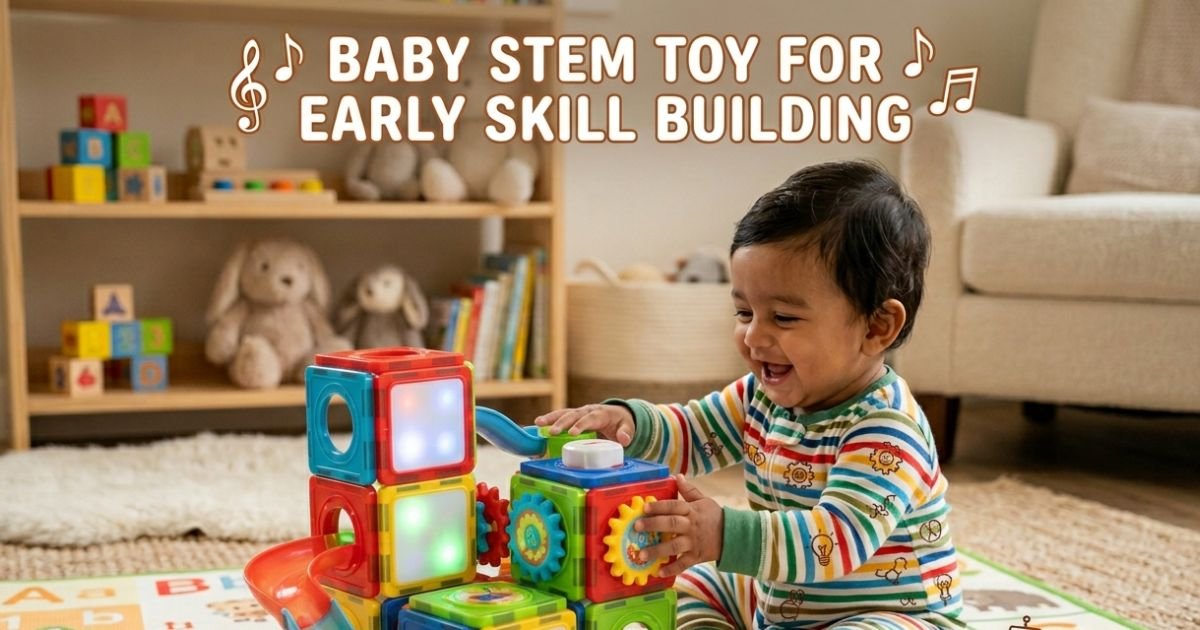
For example, interactive push-button toys (interactive baby STEM toys) like activity panels or music boards capture a baby’s attention while teaching cause and effect. When the infant presses a button and hears a sound or sees a light, they learn that one action leads to a response. These interactive panels often incorporate STEM concepts (numbers, letters, animals) into each button. As one expert notes, STEM toys are “educational” in part because they relate play to the real world and encourage discovery through trial and error. The toy above is a classic activity center: turning the numbered gears and sliding the shapes around helps the baby explore fine motor skills, counting and cause-effect in one fun session.
Each of these examples is an educational baby STEM toy that makes learning tangible. As babies play, they are building skills that set the stage for preschool math and science. Importantly, even simple everyday items can be STEM toys – stacking cups from the kitchen or measuring cups in the sandbox count as early math tools when kids use them in play. The key is interactive, hands-on exploration.
Pros and Cons of Baby STEM Toys
When choosing STEM toys, it’s helpful to weigh the advantages and possible downsides:
- Pros:
- Skill Development: STEM toys accelerate learning of math, logic, and motor skills in an age-appropriate way.
- Engagement: The interactive nature of these toys keeps babies interested. Bright colors, moving parts, and cause-effect surprises hold attention longer than passive toys.
- Versatility: Many STEM toys (blocks, puzzles, sorting sets) can be used in multiple ways, providing long-term play value.
- Educational Fun: Babies often don’t realize they’re learning – a spinning gear or stacking tower is just fun, but it also teaches physics and design thinking.
- Cons:
- Supervision Required: Some STEM toys have small parts (puzzles, beads) that require adult supervision. Always follow age guidelines to avoid choking hazards.
- Complex Assembly: A few STEM sets require assembly or setup, which parents must do. Also, very young babies still require lots of hands-on guidance to get value from a toy.
- Cost: High-quality STEM toy sets (like multipiece kits) can be more expensive than simple toys. However, their durability and educational benefit often justify the price.
- Overstimulation: A few toys with lights or sounds can overstimulate sensitive babies if used too long. It’s good to mix STEM play with calm, unstructured play too.
Overall, the benefits far outweigh the drawbacks for most families. By choosing safe, age-appropriate options and playing together, parents can mitigate the cons (like ensuring supervision) and get the most out of baby STEM toy learning.
Tips for Maximizing Early STEM Learning
To help your child get the most from these toys:
- Play Along: Join your baby with the toy. Describe what you see (“red block goes here”), count pieces together, or model how to stack. Adult involvement reinforces learning and makes play social.
- Ask Questions: Even to a very young child, simple questions encourage thinking. “What will happen if we stack one more cup?” or “How many balls are here?” Inviting them to answer (or babble responses) engages their brain.
- Encourage Exploration: Don’t worry if your baby “plays wrong.” Allow them to put pieces anywhere or use toys in unexpected ways. Open-ended exploration is the essence of STEM play. Each attempt – even a tower that tumbles – teaches cause-effect and persistence.
- Integrate STEM Concepts in Daily Life: You don’t need a special toy for every lesson. Count steps as you climb them, sort socks by color, or pour water into different cups at bathtime. These everyday activities reinforce the same skills.
- Rotate and Revisit: Keep a few STEM toys out at a time and rotate others. Repetition helps mastery. A toy the baby “figures out” this week might still offer new challenges next month, especially if you add complexity (stacking more blocks, turning the puzzle upside down, etc.).
- Be Patient and Positive: Praise attempts (“Yay, you tried!”) more than success. Building a tower or fitting a shape isn’t a race. The process builds brain cells whether or not the tower stands tall at first.
Teachers and researchers emphasize that play is where STEM begins. By making STEM learning part of playtime, you’re giving your child an important advantage. Remember NAEYC’s advice: no fancy gadgets needed just open-ended materials, time to explore, and encouragement for trying new ideas.
Conclusion
Investing in the right baby STEM toys can spark a lifelong love of learning. These educational, interactive baby toys turn simple actions into lessons in math, science and engineering. From the first stacking ring to the first counting puzzle, your little one is developing problem-solving skills, hand-eye coordination, and creativity without even realizing it.
In summary, choose safe, age-appropriate STEM toys like colorful building blocks, shape sorters, pop-up toys, and simple activity sets that encourage open-ended play. Play with your baby, ask questions, and make it fun. By doing so, you’ll help build a strong foundation in critical thinking and STEM concepts early on.
Ready to give your child a head start? Explore highly rated baby STEM toy sets and picks that fit your budget and needs. Remember: the best baby STEM toy is one that keeps your child engaged, safe, and curious. Happy playing and learning!
