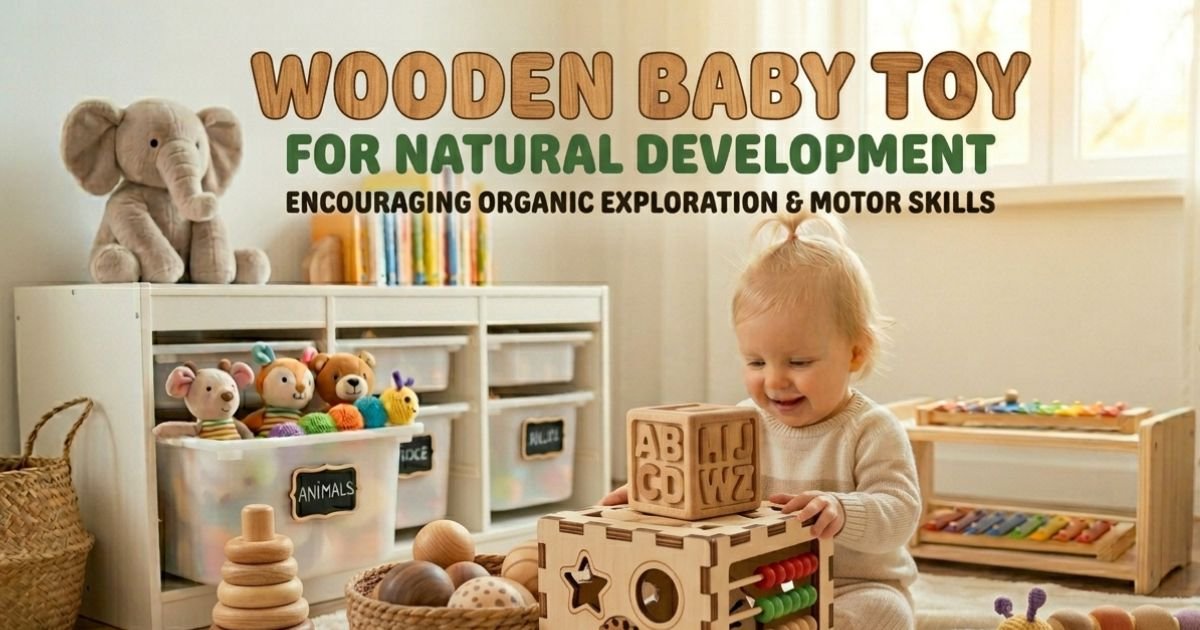

A wooden baby toy offers a simple, natural play experience that supports a child’s growth. Unlike plastic toys, wooden toys engage babies’ senses and avoid synthetic chemicals. These toys are often handcrafted from solid wood and finished with child-safe coatings, providing a tactile, durable alternative to plastic. Wooden toys support your child’s natural development through touch and imaginative play. In this guide, we’ll explore how wooden baby toys benefit sensory, motor, and cognitive development, outline safety and eco-friendly considerations, and share tips on choosing and gifting the best wooden toys for babies and toddlers.
Developmental Benefits of Wooden Toys
Wooden toys excel at promoting a baby’s development by encouraging exploration and discovery. A baby playing with wooden building blocks on a green mat. Playing with solid wooden blocks helps toddlers develop fine motor skills and hand–eye coordination. The weight and smooth texture of the wood give rich sensory feedback that plastic toys lack, engaging touch and kinesthetic senses. This sensory-rich, open-ended play encourages stronger brain connections and a calm focus.
Key benefits of wooden baby toys include:
-
Sensory Stimulation: Natural wood has a warm feel and unique grain that stimulates babies’ senses. Research shows touching wood can have a calming effect. Wooden toys often have gentle, pleasing colors or are unpainted, letting children explore texture, weight, and sometimes even smell. This sensory engagement supports development of touch and can soothe a baby’s emotions as they play.
-
Fine Motor Skills & Coordination: Grasping, stacking, and manipulating wooden toys builds hand strength and dexterity. For example, stacking blocks or fitting shapes into puzzles helps young children develop the pincer grasp and hand–eye coordination. As the child turns, balances, and aligns wooden pieces, they practice precise movements needed later for writing, drawing, or buttoning clothes.
-
Imagination & Creativity: Wooden toys encourage open-ended play because they don’t have built-in sounds or lights that dictate play. Their simplicity invites children to create their own stories. As the HABA USA blog notes, wooden toys “are less distracting” and “improve [a child’s] ability to focus, encourage imagination and create an opportunity to play creatively”. A set of wooden blocks can become anything – a house, a car ramp, a castle – limited only by the child’s imagination. This imaginative play teaches creativity and problem-solving, since the child has to invent and adapt the play scenario themselves.
-
Cognitive & Learning Skills: Many wooden toys have educational elements built in. Blocks with numbers or letters introduce early counting and literacy, while puzzles and shape-sorters teach spatial reasoning. When a child sorts colored wooden shapes or fits a wooden puzzle together, they learn about shapes, sizes, and cause-effect relationships. Arranging and balancing wooden pieces also builds understanding of physics (balance, gravity) and geometry. The hands-on trial-and-error process helps develop reasoning skills – as Nova Toys explains, children “make logical deductions” about physical concepts when playing with wooden blocks.
-
Language and Social Skills: Simple wooden figures or blocks can become props for storytelling. As children describe their block tower or pretend their wooden animal figures are talking, they practice vocabulary and narrative skills. Parents can join in to encourage language (“Where does the block go? Can you tell a story about it?”). Wooden toys can also support social play between siblings or friends, as they build together or swap pieces, learning sharing and communication through play.
-
Emotional Development and Focus: Without the flashing lights or sounds of electronic toys, wooden toys allow children to focus quietly. This can help toddlers concentrate longer and use playtime to self-regulate emotions. Studies suggest that natural materials like wood help children calm down faster and stay engaged. This emotional steadiness is beneficial for learning self-control and patience during play.
By combining tactile feedback, open-ended play, and stability, a wooden baby toy nurtures many aspects of a child’s development. Parents report that simple wooden toys, like building blocks, tend to hold a child’s interest longer than flashy electronic toys. This focus and engagement mean more time practicing skills. In short, wooden toys support a child’s growth naturally and holistically.
Safety and Quality
Safety is paramount for baby toys. Wooden toys are often considered safer by design, but it’s important to verify quality and certifications. Follow these tips to ensure the wooden baby toy you choose is truly safe and well-made:
-
Certified Safety Standards: Ensure the toy meets recognized safety standards. In the US, look for compliance with ASTM F963 toy safety requirements and the CPSIA (Consumer Product Safety Improvement Act) limit on lead and phthalates. In the EU, a CE mark indicates compliance with child safety regulations. These standards prohibit toxic paints or finishes. For example, ASTM/CPSC rules ban lead in paint and certain phthalates on any part of a child’s product. A safe wooden baby toy will either carry a certification or label (ASTM, CE, CPSIA, EN71, etc.) or come with documentation that it meets these standards.
-
Non-Toxic Finishes: Pay attention to the finish on the toy. Choose toys finished with water-based or natural coatings rather than solvent-based varnishes. As Dannico Woodworks advises, “always choose water-based paints” and sealants, since they don’t contain volatile organic compounds. Natural finishes like beeswax, carnauba wax, or plant oils are excellent and food-safe for teething toys. A high-quality wooden toy will often use an ACMI AP-certified paint (safe if mouthed) or have a clear coat of natural oil or wax. Avoid toys with gloss finishes that could chip. If a toy has a smell of harsh chemicals, consider that a red flag.
-
Smooth Construction: A good wooden baby toy should be well-made with smooth, rounded edges and no splinters. All surfaces should be sanded smooth and sealed. As the safety guide notes, infant toys especially should have “smooth, rounded edges” and be free of small parts. Check that pieces fit snugly (so parts can’t be pulled off) and that there are no sharp corners. Larger wood pieces (no smaller than ~1.25 inches in any dimension for babies) eliminate choking hazards. Also ensure moving parts (like axles on pull toys) are safely attached. Wood itself is naturally antibacterial to some degree, but still clean them regularly.
-
Durability: Part of safety is durability. A well-made wooden toy won’t easily break into sharp pieces or leave fragments. Choose solid hardwoods (like birch, maple, or beech) over soft or composite woods. The toy should feel sturdy. This longevity means fewer loose parts and less risk of breakage. (It also means you can repair and reuse the toy – unlike plastic which often must be thrown away when broken.)
-
Certifications and Marks: In addition to ASTM or CE, check for voluntary certifications that signal safety and sustainability. For example, some brands may show the FSC or PEFC label, which indicates responsible sourcing of the wood. There is no single safety certification for wood in the US beyond ASTM/CPSC, but an FSC/PEFC mark is great for ecology (see next section). Also look for the American Society for Testing and Materials (ASTM) logo or statements that lead and phthalates are tested to be below legal limits.
-
Cleaning and Maintenance: Wooden toys should be easy to keep clean. Many come with instructions like “wipe with a damp cloth”. Avoid soaking wood in water or harsh detergents which can damage the finish. A well-finished wooden toy will repel germs more than plastic, but if a toy gets sticky (from food or spills), a mild soap solution and quick drying is usually sufficient. Avoid leaving wooden toys in full sun or rain, as that could warp the wood or weaken glue joints.
By following these guidelines, you ensure the wooden baby toy is as safe as it is fun. Remember that no certification is bulletproof if the toy is poorly constructed. Always inspect any wooden toy for smoothness, and if possible buy from reputable brands or artisans known for child-safe craftsmanship.
Eco-Friendly and Sustainable Play
One major advantage of wooden baby toys is their eco-friendliness. Choosing wood over plastic helps both children and the planet:
-
Renewable, Biodegradable Material: Wood is a natural, renewable resource. As HABA points out, “wood is an environmentally friendly material” – wooden toys are “biodegradable and recyclable” when they eventually wear out. In contrast, plastic toys often end up in landfills and contribute to microplastic pollution. Indeed, plastic toys account for a significant percentage of landfill waste. Wooden toys have a far smaller carbon footprint: manufacturing them uses less energy and emits fewer harmful emissions than injection-molded plastics. And if a wooden toy breaks, you can often fix it or repurpose the parts, rather than tossing it out.
-
Sustainable Sourcing: The sustainability of a wooden toy depends on where the wood comes from. Look for woods certified by organizations like FSC (Forest Stewardship Council) or PEFC, which guarantee the timber is harvested responsibly. For example, HABA’s wooden toys carry the PEFC seal, meaning the wood is from sustainably managed forests. The new EU Deforestation Regulation (EUDR) will require proof that imported wood (like rubberwood) does not come from deforested areas. Choosing FSC/PEFC-certified toys ensures the wood isn’t contributing to deforestation. When buying, check product descriptions or labels; many ethical toy brands proudly state “FSC-certified” or “made from sustainably harvested hardwood.”
-
Chemical-Free Finishing: Eco-friendly wooden toys often use natural finishes. Beeswax, coconut oil, or water-based varnish are common because they’re non-toxic and have minimal environmental impact. Avoid polyurethanes or solvents, which are energy-intensive to produce. As noted above, the safest wooden toys use simple, natural sealants. Choosing such toys means fewer volatile compounds in your home and a smaller environmental footprint.
-
Longevity and Low Waste: Because well-made wooden toys last longer (and can be passed down), fewer new toys are needed over a child’s early years. This durability means less waste overall. Many parents report saving hand-me-down wooden toys for younger siblings. When it comes time to replace an old toy, you might even repurpose the wood or upcycle it into something new. In this way, a wooden baby toy isn’t just good for the planet during production – it stays eco-friendly throughout its use.
By selecting an eco-friendly wooden baby toy, you teach values of sustainability. It’s a gift that says you care about the environment. As one safety guide emphasizes, “safe baby toys are generally eco-friendly” – think biodegradable, chemical-free materials. Opting for wooden toys aligns with a natural nursery aesthetic and reduces reliance on plastics that persist for centuries.
Types of Wooden Baby Toys & Educational Examples
There is a wide variety of wooden toys designed for infants and toddlers. Here are some popular types and how they support learning:
Educational wooden alphabet blocks. Blocks and Building Sets: Classic wooden building blocks (plain or printed with letters/shapes) are foundational toys. Young children love to stack, build towers, and knock them down, which teaches cause-and-effect and balance. Blocks with letters or numbers turn this play into an early lesson in literacy or counting. For example, arranging A–Z blocks helps toddlers recognize letters and sounds, while stacking blocks of different sizes introduces concepts of size and sequencing. These educational wooden baby toys (like alphabet blocks) foster cognitive skills such as pattern recognition and spatial reasoning. As Nova Toys notes, these actions help children make deductions about volume and geometry.
-
Shape Sorters & Puzzles: Wooden shape-sorter boxes (where a child fits blocks into matching holes) and simple jigsaw puzzles build problem-solving skills. A wooden puzzle teaches patience and persistence as a child works to match each piece. These toys also reinforce shape and color recognition. For instance, fitting a round peg into a circular hole teaches that “this shape goes here.” This type of play improves fine motor control and hand–eye coordination as the child learns to align pieces precisely.
-
Rattles, Teethers, and Graspers: For babies under one year, wooden rattles or teethers made from untreated hardwood and food-safe finishes are great choices. A hand-held wooden rattle stimulates grasping reflexes and auditory development (the sound of wood clicking). Teething toys made of smooth maple or birch can be gnawed on safely if coated with beeswax. These simple wooden toys encourage sensory exploration babies examine wood grain, weight, and sound. Wooden teething toys also provide relief without any toxic chemicals. As the EPA notes, natural wooden toys are ideal for mouthing because they don’t contain harmful residues.
-
Pretend Play Sets: As toddlers grow, wooden pretend-play sets (toy kitchens, tool benches, dollhouses) encourage creative role play. For example, a wooden toy tea set or farm animals allows a child to act out adult routines or storytelling scenarios. Through such open play, children learn social roles and language as they pretend and narrate actions. Many of these sets come with colorful wooden accessories that also reinforce learning (e.g. wooden play fruits to learn about food and colors).
-
Mobiles and Educational Toys: Wooden mobiles hung above cribs, or Montessori toys like bead mazes and activity cubes, engage infants’ senses. An example is a wooden airplane mobile that helps visual tracking. Another is a multi-activity cube with gears, mirrors, and bead runs these stimulate curiosity and coordination. Such toys are marketed as educational wooden baby toys because they teach cause/effect, fine motor manipulation, and even simple science (e.g. spinning gears causes movement).
-
Push/Pull Toys and Walkers: Wooden pull-toys (e.g. a duck on wheels) and baby walkers with wooden frames help encourage walking and balance. The sturdy build of wood can support a toddler learning to stand and push. Toys like wooden baby walkers often feature detachable balls or rings for fine-motor manipulation, adding dual learning benefits.
-
Handmade and Personalized Toys: Many wooden toys are handcrafted. Artisans create beautifully sanded puzzles, name engraved blocks, and unique pieces. As Dannico Woodworks highlights, there’s “a special kind of magic in watching your child play with a beautiful, handmade wooden toy”. These one-of-a-kind pieces often use high-quality wood and non-toxic finishes, making them both safe and sentimental. Examples include personalized name puzzles, woodburned animal figurines, or carved stacking totems. Such handmade wooden baby toys make memorable gifts because they can be kept as keepsakes as well as toys.
-
Great Gift Ideas: Wooden toys are classic gifts for baby showers and birthdays. Consider gifting a wooden activity cube, a set of Baby’s First Blocks, or a Montessori-style puzzle board. These toys are attractive and meaningful – giving a wooden baby toy gift signals you value natural play and quality. Many parents report that beautifully crafted wooden toys become family favorites that last for years. In fact, eco-conscious retailers note that wooden educational toys make meaningful presents that both parents and babies love.
In summary, wooden baby toys come in many forms from blocks and puzzles to play kitchens and teethers each supporting a different aspect of learning. Many popular wooden toys are marketed specifically for toddlers (e.g. shape sorters for 1–2 years) or infants (e.g. rattles for 6+ months). When choosing, match the toy type to the child’s developmental stage.
How to Choose a Safe & Eco-Friendly Wooden Toy
With many options available, here’s a practical checklist for choosing the best wooden baby toy:
-
Safety Standards and Compliance: Look for toys that list or meet safety standards. Check if the packaging or product page mentions ASTM F963, CPSIA compliance, or CE/EN71 certification. These labels mean the toy has been tested for hazards. Also ensure any paints or finishes are certified non-toxic. Labels like “ACMI AP (Approved Product) Seal” or FDA compliance indicate even if chewed, the paint is safe. If shopping online, a reputable seller should mention safety in the description.
-
Non-Toxic Materials: Verify the materials. The wood should be high-quality hardwood (no plywood or chipboard). The finish should be explicitly stated as child-safe: water-based, plant-based oil, or beeswax. Avoid phrases like “lead-free” alone (which is required by law) and instead look for “AP non-toxic” or “food-grade finish.” If in doubt, contact the manufacturer or choose a brand known for transparency (many eco toy brands specify exact paints). As a rule, the toy should have no recognizable odor of chemicals. For example, water-based varnish or natural color dyes are preferred over glossy lacquers.
-
Age Appropriateness: Ensure the toy is designed for the child’s age. Avoid toys with small detachable parts for infants (0–3 years). The CPSC recommends any piece for an infant be larger than 1.25 inches in diameter to prevent choking. For older babies and toddlers (1–3 years), look for age grading on the product. This also helps ensure that the toy’s difficulty matches the child’s skill. Toys for babies should have smooth edges and sturdy construction; toys for toddlers can have more complexity (puzzles, moving parts) but still follow safety guidelines.
-
Sustainability Labels: Check for FSC (Forest Stewardship Council) or PEFC certification, which indicate the wood is responsibly sourced. These logos on packaging or product info show the manufacturer cares about sustainable forestry. Some brands explicitly mention “sustainably harvested wood” or “certified organic paint.” Choosing such products reduces environmental impact. Even if the toy doesn’t have a label, read the company’s ethics or sourcing info if available.
-
Solid Construction: Examine or inquire about the build quality. Good wooden toys should use solid joints (not wobbly glue) and natural adhesives or child-safe glue. If parts screw on (like wheels), they should be tightly secured. Avoid toys that look cheaply made (rough cuts, visible nails). A well-constructed wooden toy will feel robust. Some companies even offer spare parts or repair instructions – a sign of quality.
-
Non-Toxic Cleaning: Confirm how to clean the toy. Ideally, it should be cleanable with just a damp cloth (as Colored Organics suggests). This implies the finish is sealed. You might gently wash it occasionally with mild soap if needed, but never soak it. Make sure the instructions say “wipe clean” or similar.
-
Review Craftsmanship (Handmade vs Factory): Handmade wooden toys often emphasize craftsmanship. If buying handmade, check if the maker mentions the types of wood and finishes used. Handmade does not automatically mean safe, but many artisans use food-grade oils and organic dyes. Conversely, mass-manufactured wooden toys can be safe too if made by a reputable company. Always look for safety info rather than assuming based on how the toy is made.
By following this checklist, you’ll end up with a safe wooden baby toy that is both child-friendly and planet-friendly. For example, a wooden puzzle made of FSC-certified maple and coated with water-based finish would meet all these criteria. Even something as simple as choosing unfinished wood blocks or a natural rubberwood teether (finished with beeswax) ensures maximum safety.
Conclusion
Wooden baby toys combine classic charm with modern sensibility: they support natural development in babies and toddlers while being safe for children and the planet. These toys stimulate the senses, encourage motor and cognitive skills, and spark creativity without overwhelming a child. They are inherently safer by avoiding toxic plastics and by meeting strict safety standards. Furthermore, when sourced responsibly, wooden toys minimize environmental impact.
Whether it’s a simple stacker, an alphabet block, a teething ring, or a shape sorter, a wooden baby toy can become a child’s favorite companion and a family heirloom. For parents, these toys offer peace of mind: they last for generations and can be repaired or shared. As one woodworker put it, there’s real “magic” in a beautiful, handmade wooden toy – a magic that encourages learning and joy with every touch.
Explore wooden baby toys today: look for sustainable materials, non-toxic finishes, and age-appropriate designs. Your child’s natural development – and the planet – will thank you for it.
