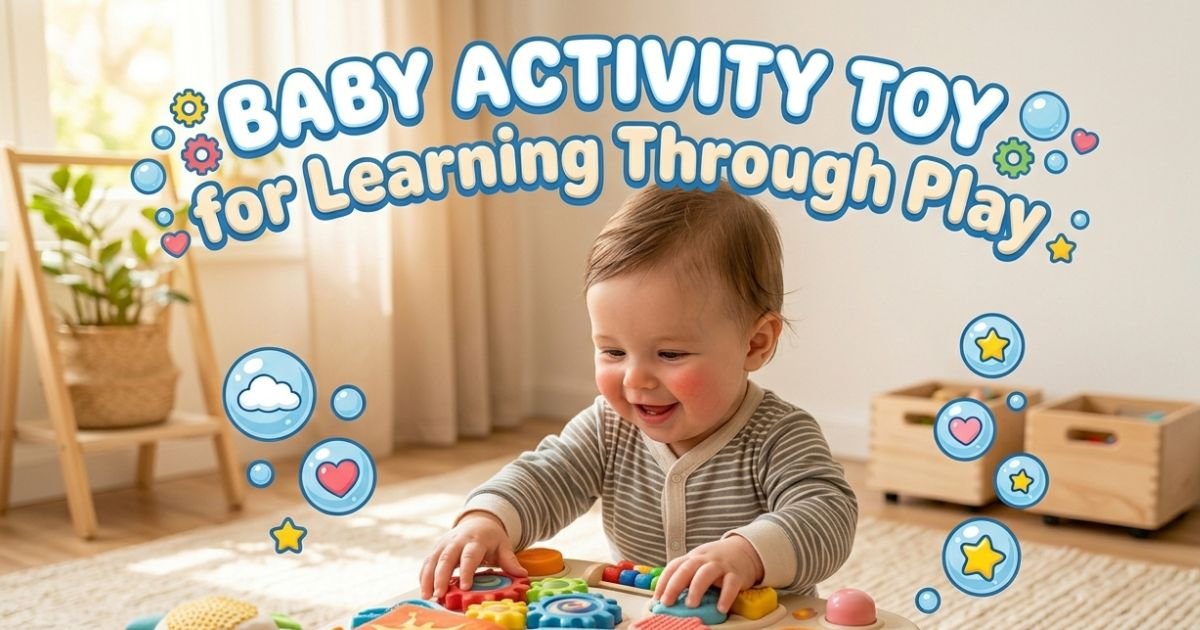

Engaging your little one with the right toys can make playtime a powerful learning experience. A baby activity toy whether a floor gym, activity center, or interactive book is designed to stimulate an infant’s mind and body. These toys encourage babies to kick, grasp, spin, and explore, helping them build skills while having fun. In this comprehensive guide, you’ll learn what baby activity toys are, how they benefit development, age-appropriate examples, and top picks of educational and interactive baby activity toys. We’ll also cover buying tips and safety guidelines so you can choose the best toy for your child.
What Is a Baby Activity Toy?
A baby activity toy is an interactive play item made especially for infants and toddlers. These toys usually feature multiple elements such as lights, sounds, textures, colors, or moving parts that respond to a baby’s actions. For example, a toy piano lights up and plays music when a baby kicks it, or a stacking cup set that snaps together. When babies press buttons, push, or pull parts of the toy, they learn cause-and-effect: their actions produce a response. This feedback is critical for learning. As one developmental resource notes, interactive toys connect a baby’s actions with outcomes, which “is critical for developing cognitive skills, motor skills, and sensory awareness”.
Baby activity toys come in many forms. Activity centers (or “play centers”) are stationary seats or walkers surrounded by attached toys and trays. Activity gyms or play mats are flat mats with arches holding hanging toys. There are also push toys, musical instruments, shape sorters, and colorful busy boxes. All these are educational baby activity toys because they combine play with learning. They often engage multiple senses – seeing bright colors, hearing sounds, and feeling different textures to keep your baby interested and to develop various skills at once. As the American Academy of Pediatrics (AAP) points out, the best toys encourage new skill growth and are key to developing children’s brains, language, pretend play, problem-solving, social interaction, and physical activity.
In short, a baby activity toy is more than just entertainment. It’s a tool for learning through play supporting your baby’s exploration, curiosity, and developmental milestones. We’ll look at the benefits and types next.
Developmental Benefits of Baby Activity Toys
Baby activity toys turn playtime into an educational experience. They help children grow across many areas:
-
Motor Skill Development: Grasping, pushing, kicking, and crawling all improve muscle control. For example, reaching for a hanging toy or pressing piano keys on a play gym builds fine motor skills (using small muscles in hands and fingers). Crawling to push a rolling ball or bounce in a jumper develops gross motor skills (large muscle movements). Research shows that infants given age-appropriate toys improved in both fine and gross motor skills. Parents.com also emphasizes that play supports fine and gross motor development. As babies kick, spin, and bat at toys, they practice coordination and strength. Activity centers often include spinners, buttons, or foot pedals specifically to exercise tiny hands and legs.
-
Sensory Learning: These toys stimulate vision, hearing, and touch. Bright colors and patterns help infants focus and track objects. Different textures (soft cloth, hard plastic, mirrors) give tactile variety. Music, animal sounds, or bells teach auditory processing. According to one expert, sensory toys “involve textures, sounds and bright, contrasting colors” which are “great developmental choices for babies”. Hearing a musical toy when they kick the mat (for instance, the Fisher-Price Kick & Play Piano Gym) can even spark a love of music. Engaging multiple senses helps babies learn about the world and keeps them interested in play.
-
Cognitive Skills: Baby activity toys often encourage cause-and-effect learning. For instance, pushing a button makes a light flash, or dropping a shape through a hole earns a reward (like a funny sound). These simple puzzles teach babies that their actions have outcomes, an important cognitive concept. They also foster problem-solving and memory; for example, after playing with a shape sorter multiple times, a child learns which shapes fit which holes. The AAP notes that toys are key to “developing children’s brains” and promoting symbolic play and problem-solving. Educational activity toys like those with numbers, letters, or color matching – can introduce early math or language concepts as well.
-
Social and Emotional Development: Many activity toys encourage interaction between baby and caregiver. Simple games like peek-a-boo toys or play mats often lead parents to respond with smiles and conversation, building communication skills. The AAP stresses that the most educational toys are those that foster parent-child interaction and imaginative play. As one pediatrician puts it, “when children play with parents the real magic happens” whether it’s pretending with toy characters or building blocks together. Even solo play builds independence and confidence: toddlers who explore a toy table on their own learn to play independently and feel proud of solving challenges themselves.
-
Language Skills: Many modern baby activity toys include songs, nursery rhymes, or spoken instructions. Hearing these repeated helps babies learn sounds, words, and eventually language. While not every activity toy focuses on language, ones that sing alphabets or count can introduce early vocabulary. At minimum, playing around an activity toy gives parents chances to narrate what’s happening (“Look, your baby pushed the yellow button!”), which boosts language development.
In summary, baby activity toys are powerful educational tools. They blend fun and learning by engaging multiple senses and providing challenges appropriate to babies. As one parent guide sums up, an activity center provides “sensory exploration, fine motor practice, short independent play sessions, and interactive learning opportunities”. We’ll now explore the different kinds of these toys and what to look for.
Types of Baby Activity Toys
There are several popular styles of baby activity toys, each suited to different stages and play preferences:
-
Activity Centers and Stations: These are seated or standing play devices with trays of attached toys. Classic examples include exersaucers and jumperoo-style seats. A stationary activity center typically has a 360° rotating seat surrounded by built-in toys (buttons, mirrors, spinners). A jumper/exersaucer adds a bounce feature (via springs or a bungee) so baby can bounce safely. Activity centers allow babies (usually 6+ months) to swivel and reach various items, practicing reaching and coordination. They keep baby in one place and free up parent’s hands briefly. However, experts note these are best for short, supervised sessions – see Tips below.
-
Play Mats and Activity Gyms: These are flat mats (for tummy time or laying) often with overhead arches or detachable toys. The Fisher-Price Glow & Grow Kick & Play Piano Gym is a popular example: it’s a floor mat with a built-in piano at one end and dangling toys above. Babies can kick the piano (making music light up) or swat the hanging toys. Play mats are excellent for very young infants (3-6 months) who aren’t yet sitting or standing. They encourage reaching, kicking, and rolling. Because they lie on the floor, they’re very safe and versatile. Mats can often be folded for travel or storage. Many parents love them as an interactive baby activity toy for infants.
-
Interactive Books and Electronic Toys: For slightly older babies (6-12+ months), interactive books (with flaps, textures, or sound chips) and musical toys come into play. While not “centers,” they fit the baby activity toy theme when used for play. These might include light-up electronic toys, baby laptops, or plush toys that respond to touch. They often promote cause-effect and early learning (shapes, numbers, colors). However, AAP advises against relying solely on screens – simpler traditional toys are often best.
-
Push Toys and Walking Assistants: As babies approach toddlerhood (around 9-18 months), they start standing and walking. Push toys (wheeled walkers or push cars) become useful activity toys. They offer a support to pull up on and push around, strengthening leg muscles and encouraging movement. Some walkers have built-in activity panels with spinning gears or shapes for sitting play as well. These double as gross-motor builders and activity centers in one.
-
Montessori and Sensory Toys: Though not activity “centers,” consider including Montessori-style toys such as wooden cubes with beads, stacking rings, or object permanence boxes. These educational baby activity toys encourage focused play and fine motor skills. For example, an activity cube has multiple sides (maze, bead chain, shape sorter) and is great for one-year-olds to explore in many ways. Even simple household items (like a plastic bowl or wooden spoon) can be learning toys under supervision. The key is varied textures and open-ended play, which research shows often leads to better learning than flashy gadgets.
Stationary vs. Jumper: Activity centers usually fall into these two categories. A stationary center has a non-bouncing seat allowing 360° play. A jumper adds bouncing fun. Jumpers (or exersaucers) can delight mobile babies who love to wiggle; stationary seats often hold an infant’s attention longer. Some families even keep both. Consider your baby’s temperament: do they enjoy gentle bouncing or do they like to calmly explore at their own pace?
Whichever type you choose, look for variety in the play elements textured parts, spinners, mirrors, and things to press or slide. This keeps babies engaged and working different skills. We’ll discuss features to look for in Choosing below.
Developmental Milestones and Toy Recommendations by Age
Choosing the right toy often depends on your baby’s age and abilities. Below is a quick guide to age-appropriate activity toys:
-
0–3 Months (Newborn Stage): Babies at this stage mostly observe and make small movements. Suitable toys are high-contrast and sensory. Think simple: a crib mobile with gentle music, a black-and-white or high-contrast cloth book, or a soft rattle that’s easy to grasp. Even brightly-colored baby gym cards or a mirror strapped to a crib can fascinate. The goal here is sensory stimulation and letting baby watch your face or toys to build early focus.
-
4–6 Months: Now babies start reaching and grasping. Toys should invite these actions. Teethers (often textured or chilled) help with gums and encourage mouthing exploration. Soft squeeze toys or plush animals are good for grabbing. A simple play gym or mat with dangling toys (like rings or animals) is ideal – baby can bat at or hold them, strengthening their grip and coordination. Peek-a-boo books or stacked cloth blocks that collapse also begin teaching object permanence (the idea that something still exists even when hidden).
-
6–9 Months: Babies can usually sit and may start crawling. Introduce stacking blocks, nesting cups, and shape-sorters to boost fine motor and problem-solving. Toys that roll or make sounds when touched promote crawling and general movement (gross motor). Interactive sound toys (like a drum or piano keys) that respond to pounding or kicking are great now. Busy boxes toys with knobs, latches, buttons, and holes are excellent for this age. They encourage baby to manipulate objects and learn cause-and-effect.
-
9–12 Months: Babies now pull to stand and may walk with support. Push toys or sturdy walkers become useful for balance and foot coordination. Look for ones with broad bases for safety. Simple puzzles (wooden pegs that fit into holes) and shape sorters continue fine-motor practice. Sensory balls (soft, textured balls) are perfect for this age babies can roll, crawl after them, or squeeze them. Toys that allow items to be placed in containers (like balls in a bucket) also build hand-eye coordination.
-
12–18+ Months (Toddlers): The activity toys can evolve into more complex forms. Activity tables with buttons, sliders, and spinners can occupy older babies and young toddlers. Larger stackers and puzzles with knobs prepare toddlers for more advanced play. Ride-on toys and tricycles begin to develop gross motor skills further. By now, books, music, and pretend-play sets (toy phones, pans, dolls) also count as valuable activity toys, promoting language and imagination. The key is that “around their first birthday, we see cognitive development really grow. Cause-and-effect toys are fun, yet challenging,” say experts.
Tailor the toy to your child’s development. As BabyTrend suggests: for young infants (4–6 mo) pick supportive toys with gentle stimulation; for older babies (6–12 mo) choose more interactive, convertible toys; and for toddlers, move toward activity tables or stations that suit their new standing and walking skills.
How to Choose a Baby Activity Toy
With many options available, here are some key factors to consider when selecting a baby activity toy:
-
Safety First: Check age recommendations closely. Toys for infants should have no small parts that could be choking hazards. All materials should be non-toxic and sturdy. Certified safety standards (like ASTM or CE marks) mean the toy has passed basic tests. If choosing an electronic toy, ensure buttons and batteries are well secured. Always supervise baby while playing. As AAP advice notes, the most important purpose of play with toys in infancy is to facilitate warm, supportive interactions; make sure the toy doesn’t isolate the baby or pose risk.
-
Developmentally Appropriate: Pick a toy that matches your child’s current skills but also has challenges. If it’s too hard, baby will get frustrated; too easy, baby will get bored. For example, a movable activity seat with 360° toys is great once baby can sit up, but not suitable for a newborn. Adjustable or multi-stage toys (with changing modes) can “grow” with your child. The Fisher-Price 3-in-1 Sit-to-Stand Activity Center is a good example: it starts as a floor play mat for newborns, then converts into a seated center and finally an activity table for toddlers. Having multiple height settings, as many centers do, ensures a snug fit as baby grows.
-
Variety of Stimuli: Look for toys that engage several senses and offer different activities. Good activity centers include textured elements, spinners, mirrors, buttons, music, and different materials. This variety keeps baby exploring. For instance, a play station might have a bead roller on one side and a piano keyboard on another. Some experts even note that simpler, action-responsive toys (those that the baby manipulates themselves) often give more developmental benefit than toys that simply flash lights or play music without interaction. In other words, interactive elements (those that baby must press or move) are better for learning.
-
Ease of Use and Cleaning: Babies are famously messy. Ensure the toy is easy to clean. Many activity seats have machine washable seat pads and wipeable plastic trays. Parts that can be detached for cleaning are a plus. Toys on a play mat can often be tossed in the wash. Also consider where you’ll use or store it: bulky jumpers take space and may not fold, while a mat can roll up easily.
-
Engagement (Not Overstimulation): It’s tempting to get a toy with flashing lights and loud music, but balance is key. The American Academy of Pediatrics warns that overly flashy electronic toys can distract from real learning. The best toys encourage imagination and parent-child play, not just screen-like entertainment. Look for volume controls so you can adjust sound, and consider simpler toys along with any electronic ones. Sometimes, a colorful wooden activity cube can engage a child just as much as a gadget.
-
Budget and Durability: Activity toys range widely in price. Setting a realistic budget is wise (many good mid-range toys exist). A higher price doesn’t always mean better quality. Because babies outgrow activity centers fairly quickly, some parents opt for secondhand or basic models. Ensure any used toy is in good condition and recall-free. If budget allows, multi-stage or convertible toys often have the best long-term value, since they can become toddler tables or remain useful past infancy.
In summary, prioritize safety and developmental value. An ideal baby activity toy is sturdy, age-appropriate, and offers rich, hands-on play. As one buying guide advises: “When choosing the best baby activity center, prioritize safety, adjustability, developmental value, and durability”. With the right choice, an activity toy can become a fun, practical piece of gear that grows with your baby.
Top Baby Activity Toys (Our Picks)
To give you an idea of excellent options, here are some top-rated baby activity toys and their pros and cons. These picks cover various styles and price points:
Best Overall: Fisher-Price 3-in-1 Sit-to-Stand Activity Center
- Description: This versatile activity center transforms as your child grows. It starts as a soft play mat for newborn tummy time, then converts to a seated center with a rotating 360° seat, and finally to an activity table for toddlers. It features three adjustable height positions, colorful toys attached around the tray, and a smooth-spinning top for reaching. Many pieces (the seat cover, toys) are detachable for cleaning.
- Pros: Multi-stage use (mat, infant center, toddler table) adds longevity. Rotating seat lets baby reach all around easily. It offers “a lot of sensory exploration” to keep baby engaged. Fabric parts are machine-washable, and toy pieces can be wiped down or removed. Testers noted it was bright, playful, and “easy to keep clean”.
- Cons: It’s larger and pricier than basic centers. It doesn’t fold flat for storage, so it takes up more space. Some parents may find it bulky.
This model excels because it “encourages movement and exploration,” to quote a pediatric therapist. Dr. Erin Orban (PT, DPT) recommends centers where babies “can reach, bat, kick, and turn their heads,” and this design checks those boxes.
Best Budget: Fisher-Price Glow & Grow Kick & Play Piano Gym
- Description: This affordable mat-and-toy combo is a favorite for young infants. It lies flat on the floor and features a small piano at one end and a semicircular bar of dangling toys (like a spinning zebra and a snake teether). When baby lies on their back and kicks, the piano plays music and lights up. The mat has colorful jungle animal prints to stimulate vision. It’s lightweight and folds up for storage.
- Pros: Very inexpensive and compact. Mat folds, and the plastic piano base is only 18 inches deep, so it won’t fill a room. The musical songs are surprisingly pleasant – testers even found them “catchy” rather than irritating. It provides cause-and-effect play (kick the piano, it plays). Many babies love dancing to its music (studies note even parents enjoy it!).
- Cons: The mat is relatively thin padding, so on hard floors it might feel firm; some parents add an extra blanket for cushioning. Also, it’s meant for baby in supine or tummy position – once baby sits up solidly, its usefulness declines.
Overall, the Kick & Play Piano Gym is a simple interactive baby activity toy for infants. As one parent tester said, “He seems to really like the music and will dance to the tune, which has been so fun to watch”. It’s a great starter toy for 0–9 month olds.
Best Multi-Stage: Skip Hop Baby’s View 3-in-1 Activity Center
- Description: This is a high-quality three-mode activity station. It functions as a swivel-seated center, a toddler play table with lights and a piano, and a flat play table as baby grows. Assembly is tool-free, and it’s lighter than some bulky centers. It includes 25 different play activities around the rim: a bead chain, spinning ball, colorful beads, gears, a sliding bug, and more.
- Pros: Extremely versatile. Unique features include a “viewing window” so a seated baby can see their own feet pressing the four-key piano (an excellent lesson in cause-and-effect). It even has a dishwasher-safe snack bowl so your child can munch safely while playing. The base has grippy feet for stability. One pediatric PT notes the adjustable footboard lets a toddler’s feet stay flat and aligned – an ergonomic plus for standing play. Many parents like its modern look: toys are fun yet not overly bright.
- Cons: Lacks soft teething toys – it has mostly hard plastic parts. Some babies may chew on plastic if left, so parents should provide separate teethers. Also, it’s a bit more expensive than simpler models.
This Skip Hop model is great for babies 6–18+ months because it grows with them. It offers a huge variety of activities (25 total) which helps prevent boredom. A mom tester even reported her toddler enjoying it alongside her baby, playing the piano to entertain.
Best for Infants: Lovevery Play Gym
- Description: The Lovevery Play Gym is a premium floor gym designed especially for young infants. It has a thick, plush playmat and a tall wooden X-frame holding five zones of hanging toys (like a teething ring, mirror, rattle, and sensory squares). Each zone is crafted to teach a specific skill (focus, language, sensory exploration, object permanence, etc.). The overall look is minimalist and wooden, with a natural feel.
- Pros: Very high-quality materials. The mat is large and thick, so it’s comfy for rolling and tummy time. Assembly is quick (no tools needed). Because the frame is tall, it’s easy to slide baby underneath the hanging toys. The varied textures and movable pieces provide rich sensory feedback. Developers consulted experts: as Dr. Crosby notes, the best activity centers let babies “press buttons, spin wheels, touch various textures, [and] see a variety of colors and shapes”. The Lovevery gym does all of this. Many babies find it very engaging; one tester said the hanging bell kept her baby’s attention longer than most toys.
- Cons: On the downside, the soft mat attracts hair and debris more than plastic mats. Also, it’s pricier than basic gyms. It’s essentially a mat, so it doesn’t have electronic sounds or lights (which can be a pro or con depending on your view).
This gym is ideal for newborns up to around 6-9 months, until baby starts sitting up. It’s essentially a baby activity toy center for tummy time – giving infants a safe, padded space to explore sights and sounds overhead. As Dr. Crosby summarizes, it provides “the kind of rich experience” that helps babies explore and learn from interacting with toys.
Also Consider: Other notable activity toys include the Oribel PortaPlay (a 4-in-1 convertible station), Baby Einstein Music & Lights Gym, and wooden activity cubes (e.g. Melissa & Doug’s). Activity tables like the VTech Sit-to-Stand Learning Walker can be great for active toddlers. Always check that any toy is appropriate for your child’s age and development stage.
Tips for Using Baby Activity Toys
When introducing an activity toy to your child, keep these guidelines in mind:
-
Limit Session Length: Use activity centers or jumpers only in short, supervised sessions – about 15–20 minutes at a time. These toys are meant to supplement play, not replace other important activities (like tummy time, supervised floor play, or parent interaction). If your baby shows fatigue or fussiness, give them a break and a change of scenery.
-
Supervise Always: Never leave your baby alone in an activity center, walker, or jumper. Even with straps or support, keep the session safe by staying nearby. The AAP notes that activity toys should be used “as long as the parent does not leave the child unattended”.
-
Combine with Other Play: Balance use of structured toys with free play. Lay them on the floor with a few simple objects (blocks, balls, or even a pillow) so they can move and explore. Unstructured play on the ground helps develop crawling and overall strength, which centers alone cannot provide.
-
Rotate Toys: Keep your baby’s interest by rotating toys every few weeks. Introducing a new shape sorter or switch-up of hanging toys will re-engage curiosity. When using an activity center, sometimes take off a toy to use on its own in another area (e.g., bring a rattle from the center to the crib).
-
Engage Together: Make playtime interactive. Sit near your baby, talk to them about the toys, or demonstrate actions (e.g., spin a wheel, press a button). According to experts, playing together is very beneficial – it reinforces learning and strengthens the parent-child bond. For instance, say things like “Can you get the blue ball? Push here!” to encourage understanding.
-
Be Mindful of Overstimulation: Some babies can get overwhelmed by too many sounds or lights. If your baby seems fussy or looks away, switch to simpler play or quieter mode. Choose models with adjustable volumes or the ability to turn off electronic features when needed.
By following these practices, you’ll make sure playtime remains positive and developmental.
Conclusion
Baby activity toys are more than just playthings they are dynamic learning tools that help infants and toddlers develop critical skills. From first-month sensory toys to colorful activity centers for young walkers, the right toys can boost your child’s fine motor skills, cognition, and sensory awareness (all while keeping playtime fun). We’ve covered why these toys matter, how to pick them, and even the best options on the market.
When choosing a baby activity toy, remember to match it to your child’s age and interests, ensure it’s safe and sturdy, and supervise its use. With the right educational and interactive toys, you’ll be giving your baby a head start in learning through play. Explore some of the recommended baby activity toys above and let your little one’s curiosity lead the way to discovery. Happy playing!
Sources: Expert pediatric and parent resources on child development and toy safety, and product tests/reviews, inform this guide.
