
Parents today seek ways to boost baby’s early learning and smart development. A baby Montessori toy is one popular solution. Montessori-inspired toys are simple, hands-on playthings designed to teach through open-ended exploration rather than passive entertainment. These toys use natural materials (often wood), focus on one skill at a time, and invite babies to think, touch, and experiment. In this article, we’ll define what a Montessori baby toy is, explain how these educational toys support infant development, highlight key benefits (like fine motor and cognitive skills), and offer tips for choosing the best baby Montessori toy set for your child. By the end, you’ll understand why many parents view these wooden, educational baby Montessori toys as a foundation for early learning.
What Is a Montessori Baby Toy?
A Montessori toy is a learning tool intentionally designed to encourage a child’s natural curiosity and development. Unlike flashy plastic toys, Montessori toys are “passive” they don’t run on batteries or lights so the baby is active, not the toy. In practical terms, this means a Montessori baby toy is simple, open-ended, and purposeful. As one Montessori guide explains, such toys “promote engagement and serve a learning purpose, rather than just entertainment”.
In other words, a Montessori baby toy is an educational baby learning toy that helps infants explore and master skills on their own. For example, instead of a musical toy that plays a song when pressed, a Montessori toy might be a set of wooden blocks that a baby can stack and knock down, learning about cause and effect through play. Maria Montessori herself recommended that toys be made from natural materials and reflect real life – for instance, a child-sized broom or a fabric doll – so babies learn through “real-world” experiences.
In summary, a baby Montessori toy is not a specific product line but any simple, hands-on toy aligned with Montessori principles: natural, safe, and designed for independent play and learning.
Key Characteristics of Montessori Toys
Montessori baby toys follow several distinct principles. These ensure the toy supports development rather than just distraction. Key features include:
-
Child-led, low-tech play: Montessori toys are passive, meaning they have no batteries or flashing sounds. This keeps the focus on the child’s actions. As one guide notes, true Montessori toys are “passive” so that “the child should be the one playing; not the toy”. For example, a wooden rattle requires the baby to shake it for a sound, rather than pressing a button to hear a recorded song.
-
Single-focus sensory design: Each toy isolates one sense or skill. Toys are simple, not overloaded with lights and sounds. Montessori educators emphasize that the less busy a toy is, the more deeply a child can engage with it. A classic example is a black-and-white board book for newborns: its high-contrast images stimulate vision without overwhelming the baby.
-
Realistic, familiar objects: Montessori observed that young children crave exposure to reality. So many Montessori toys are realistic miniatures of everyday items. They use clear shapes and images (no cartoon exaggerations) so the baby learns about the real world. For instance, a set of wooden animal figures or blocks painted like real fruit gives the child a true-to-life concept, not a fanciful one.
-
Natural, durable materials: Wood, metal, and fabric are preferred materials. Montessori even allowed breakable items (like glass or wood) instead of plastic, believing that when children can physically feel the weight and fragility of materials, they learn responsibility and care. In practice, many Montessori toys are wooden because wood feels warm and is sustainably sourced. Natural materials also give rich sensory feedback: a wooden toy has a different feel and sound than plastic. (That said, Montessori guides clarify toys don’t have to be wooden – any safe, natural-feeling material works.)
-
Simplicity and purpose: Montessori toys usually have one clear purpose. They are stripped of extra parts and gimmicks so the child can focus on learning that one skill. As one source explains, Montessori toys “remove unnecessary and flashy parts”. For example, a simple shape sorter lets a baby match shapes to holes – that’s it. There aren’t extra buttons, lights, or textures to distract from that task. This purposeful design aligns with developmental goals (counting, sorting, pouring, etc.).
-
Hands-on, open-ended play: Montessori toys invite exploration. Many are open-ended, meaning there’s no single “right” way to play with them. A wooden stacking ring set can be stacked in different orders; a set of blocks can be arranged many ways. This open play “develops problem-solving skills, decision-making, and a sense of accomplishment” as children experiment. By allowing creativity, the child learns to think critically and explore solutions, rather than just following instructions.
Taken together, these traits make Montessori toys stand out from ordinary toys. They encourage active learning (child-driven) using simple, real materials. This kind of design keeps babies curious and focused on the task, laying the foundation for meaningful play.
Benefits of Montessori Baby Toys for Development
Montessori baby toys aren’t just cute and natural they have concrete developmental benefits. Because they’re designed around child-led play, they support infants’ growth in many areas. Key benefits include:
-
Encouraging independence and confidence: Montessori toys are often self-correcting or straightforward, so babies can figure things out on their own. Kids USA Montessori notes that children using these toys “can spot their own mistakes and solve problems independently,” which builds confidence and a sense of control. Even simple actions (like dropping a toy through a hole) become learning opportunities, and the child learns self-reliance from the start.
-
Improving focus and concentration: Because Montessori toys are minimalistic (not overstimulating), babies tend to stay engaged longer on a single toy. This helps develop sustained attention. For example, a baby may explore a wooden puzzle for minutes, touching it from all sides, rather than switching rapidly between noisy toys. Over time, this attentive play forms the building blocks of longer concentration spans in learning.
-
Building fine and gross motor skills: Many Montessori toys encourage grasping, stacking, pouring or carrying. Handling objects builds hand-eye coordination and muscle control. As Kids USA explains, activities like threading beads or carrying small trays “strengthen muscles and coordination, aligning with early childhood milestones”. For instance, a baby stacking wooden rings or picking up a rattle exercises the pincer grasp and arm movement. Even rolling a ball or pulling a toy on a string helps gross motor development. These hands-on skills are critical for later tasks like writing or self-feeding.
-
Fostering practical life skills: A hallmark of Montessori play is mimicking real-life tasks. For babies and toddlers, that might be pouring water from a small pitcher, dressing a doll, or sweeping with a miniature broom. These activities teach responsibility and daily living skills. Kids USA points out that Montessori toys “mimic everyday tasks” (pouring, sweeping, dressing) and help children develop responsibility and practical life skills. Even a simple pouring toy helps coordination while introducing the concept of serving drinks, building a sense of accomplishment from doing a real job.
-
Enhancing problem-solving and cognitive thinking: Because Montessori toys invite experimentation, babies learn to solve problems on their own. Kids USA says these toys let “children explore and test outcomes,” sharpening critical thinking. For example, when a baby plays with an object permanence box (dropping a ball and seeing it reappear), they learn cause and effect and that hidden things still exist. This trial-and-error play cultivates a curious, analytical mind.
-
Stimulating sensory development and learning: Natural materials and simple designs offer rich sensory experiences. Touching different textures (wood, fabric, metal), seeing real-life colors, and hearing natural sounds (wooden blocks clicking) all engage the senses. According to one Montessori source, sensory play “promotes cognitive growth by encouraging hands-on exploration, developing neural pathways”. In practice, this means a baby using a textured ball or wooden rattle is building the brain connections for understanding the world through sight, sound, and touch.
-
Promoting language and social skills: Even in infancy, Montessori play can encourage language. Parents can name objects (“This is a red block”) or describe actions, which grows vocabulary. Kids USA notes that sequencing steps and naming textures in Montessori activities “naturally encourage vocabulary growth and verbal expression”. As toddlers, children often play together with Montessori toys (like pass blocks or help each other stack), which can foster cooperation and social skills. (Some Montessori activities are explicitly designed for group work, boosting social-emotional development.)
-
Building emotional resilience: Repeatedly playing with Montessori toys can help a child develop patience and resilience. Because the toys are not instant-win gadgets, babies learn to try, fail, and try again. Over time this trial-and-error builds a growth mindset. One source notes that Montessori play teaches children “the confidence to try again when something doesn’t work,” fostering persistence. In short, babies learn both success and failure in a safe way.
In summary, Montessori baby toys support holistic development. They go beyond mere entertainment to provide purposeful play that boosts independence, focus, motor coordination, sensory integration, and even social-emotional growth. The payoff is a smarter, more capable baby who learns to solve problems and explore with confidence from an early age.
Popular Montessori Toys for Babies
Montessori principles suggest specific types of toys for babies and infants. Below are examples of common Montessori baby toys that align with these principles:
-
High-contrast books and Montessori mobiles: For newborns (0–3 months), black-and-white or simple pattern books are ideal. Babies see high-contrast images best at birth, and these books can increase focus and optic nerve development. Similarly, Montessori mobiles (simple hanging objects at baby’s eye level) support visual tracking and coordination. Guidepost Montessori explains that such mobiles “support baby’s developing vision and coordination skills” when shown during wakeful play. A popular DIY example is the classic “wooden ring on a ribbon” mobile, which babies learn to reach for.
-
Wooden rattles and grasping toys: Around 3–6 months, babies start grabbing objects. Wooden rattles or simple grasp rings are great Montessori toys here. A wooden rattle is more than a noisemaker; it teaches tracking (following the rattle with eyes as it moves) and fine-motor grasping. The weight of a wooden ring also feels satisfying in baby’s hand. A ball grasping toy or soft fabric cube provides multiple textures for sensory learning and encourages babies to practice opening and closing their hands.
-
Sensory balls and textured toys: Soft sensory balls or rubbery grasp balls (Montessori-inspired) help little ones practice holding and transferring objects between hands. Each ball’s texture provides a different sensory experience. These also encourage movement during tummy time, as babies push or roll a ball. By 6–12 months, babies enjoy textured stacking balls or fabric balls which refine hand-eye coordination and give playful tactile stimulation.
-
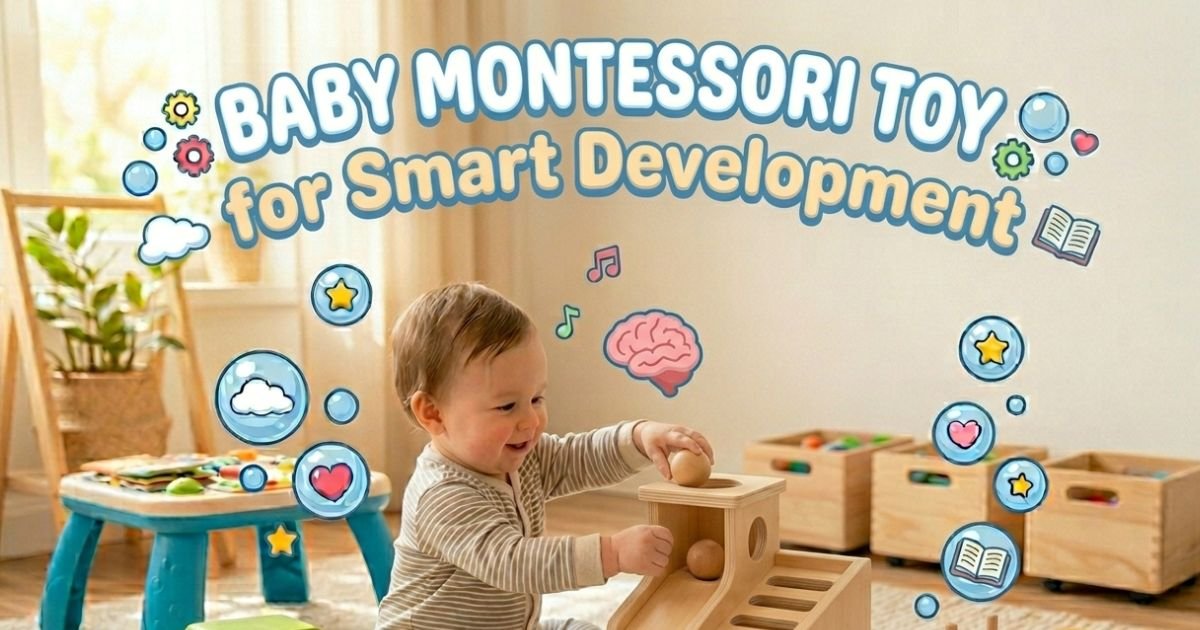
Object Permanence Box: This classic Montessori tool is a must-have for infants around 8–12 months. It’s a simple wooden box with a hole on top. The baby drops a small ball in the hole and then retrieves it from the box’s bottom. This reinforces the concept of object permanence (things exist even when hidden) while strengthening hand-eye coordination. The American Montessori Society notes that the Object Permanence Box “enables the youngest learners to explore hand-eye coordination and become familiar with object permanence”.
-
Shape sorters and puzzles: From about 9 months on, babies can handle simple shape-sorting toys (blocks of various shapes to fit into cutouts). These refine fine motor skills and introduce geometry concepts. Similarly, simple wooden puzzles (e.g. large-piece peg puzzles or knob puzzles) are excellent. They help with language (naming shapes or animals on the puzzle) and motor skills. One Montessori blogger notes that even a basic 3-piece wooden puzzle can boost language and hand-eye coordination. In fact, straightforward puzzles “are excellent for language development… fine motor skills and hand-eye coordination, problem-solving, shape recognition and memory”.
-
Stackers and nesting toys: Wooden stacking rings or nesting cups give babies practice with balance and size order. Even simple cylindrical stackers help babies refine their pincer grasp and spatial awareness. (Fisher-Price’s Montessori stacking shapes, for example, earned an AMS Seal of Excellence and are noted to “help strengthen concentration, fine motor skills, and hand-eye coordination” as toddlers stack shapes.) Similarly, nesting boxes or cups teach concepts of “big to small” and encourage problem-solving.
-
Baby-safe mirror: A non-breakable mirror at baby’s level is a Montessori favorite. Seeing their own reflection entertains infants and builds visual tracking. It also introduces self-awareness a key developmental milestone. Placing a mirror near the play area can make tummy time more engaging. Guidepost Montessori suggests mirrors in play areas so babies learn movements and expressions.
-
Musical instruments: Simple instruments like wooden maracas or tambourines are Montessori-friendly. Shaking a maraca or tapping a drum works on motor skills and timing. Plus, studies show introducing music early can create more neural connections in the brain. The Montessorimethod blog mentions that infants love “noisemakers like maracas”, which build fine and gross motor skills by picking them up and shaking them.
-
Practical life toys: Even young babies can start to imitate life tasks. For example, miniature baby-sized brooms, dusters, or cloths invite a baby to participate in caregiving. While more common for toddlers, simple tasks (carrying a small tray, wiping with a rag) can be safe for some 9–12 month olds under supervision. By toddlerhood, realistic baby dolls also fit here – caring for a doll teaches empathy and self-help skills (dressing, feeding).
-
Busy boards and activity centers: Busy boards are flat boards with locks, wheels, buttons, and latches that little hands can manipulate. They cover a range of fine-motor challenges in one place. A Montessori busy board will be wooden and free of electronics. These boards entertain and build dexterity: turning a key, sliding a latch, or flipping a switch trains the fingers. Many parents use a busy board as part of a toy rotation. (Note: choose one that is sturdy and age-appropriate.)
-
Toy Sets: Many Montessori enthusiasts use toy sets combining several items. For example, a baby toy set might include stacking rings plus a small wooden puzzle. These sets ensure variety while sticking to Montessori themes. When choosing a baby Montessori toy set, look for collections that include complementary items – for instance, a stacking toy, a shape sorter, and a soft ball. This way, babies can explore multiple skills (sorting, stacking, grasping) from one purchase.
Each of the above toys embodies Montessori values: they are educational baby Montessori toys that focus on specific skills and invite the baby to learn by doing. As your baby grows, you can swap in more challenging versions (a 12+ month toddler puzzle or walker toy) – the same principles apply.
Montessori vs. Traditional Baby Toys
It helps to compare Montessori toys with typical baby toys. Traditional toys often aim to entertain first with flashing lights, music, and multiple buttons. They tend to work passively (press a button and it lights up). In contrast, Montessori toys require active engagement: the child must hold, move, stack, or assemble parts to get a result. As Kids USA Montessori points out, Montessori toys make children “thinking, moving, solving, and growing with each use,” whereas many traditional toys simply distract.
Pros of Montessori toys: They educate through play, targeting cognitive and motor development. They promote independence (the child figures it out) and focus (less overstimulation). Many Montessori materials are built to last (durable wood, safe paint) and can be used for years, even passed down.
Cons: Because they are designed for learning, some might argue they can be “too focused on education” (little bells-and-whistles fun). Also, high-quality wooden toys can be more expensive than plastic alternatives.
Pros of traditional toys: They are often cheaper and very colorful, so babies may grab them more enthusiastically at first. They might offer novelty (character themes, sounds) that short-term entertainment.
Cons: Traditional toys rarely encourage sustained focus or problem-solving. A baby quickly grows out of a noisy toy or becomes habituated to it. Many are made of cheap plastic and may not hold interest after the initial flashing and jingling stops.
In a nutshell, Montessori baby toys offer purposeful learning while traditional toys offer instant fun. For smart development, the Montessori approach has proven advantages: higher-quality play that often yields faster skill gains in attention, coordination, and creativity.
How to Choose the Best Baby Montessori Toy
When shopping for a baby Montessori toy, keep these guidelines in mind:
-
Natural and safe materials: Look for toys made of wood, metal, or fabric, painted or finished with non-toxic substances. Montessori experts stress “natural materials offer rich sensory experiences and tend to be more durable”. For example, many Montessori-certified toys are made of FSC‑certified wood with water-based, non-toxic paint. Avoid cheap plastics that can break into sharp pieces.
-
Single-purpose, age-appropriate design: Each toy should focus on one skill or concept. Montessori toys usually target one learning goal at a time (color matching, stacking, etc.). So choose toys that match your baby’s current stage. Too easy and they’ll lose interest; too hard and they’ll get frustrated. For instance, a simple shape sorter is great for a 9-month-old, but an 18-month-old might need a puzzle with more pieces.
-
No batteries or gadgets: A genuine Montessori toy won’t have lights, sounds or require charging. The best toys are those that let the child be fully in control. Avoid toys that do tricks for the baby; instead pick those that respond only to the baby’s actions. This ensures the baby is thinking, not just watching.
-
Durability and quality: Since babies test toys by chewing and throwing, choose sturdy, well-made items. Montessori toys are an investment – many last for years or can be handed down to siblings. Durable wood is ideal. Check that there are no small parts or cords (choking hazards), and that edges are rounded and finishes are smooth.
-
Compact selection and rotation: A common Montessori tip is to offer just a few toys at a time, rather than an overflowing toybox. This helps the baby focus on each toy. Place toys on a low shelf or in baskets within baby’s reach. Rotate toys periodically to keep interest. For example, present 3–4 toys and when the baby seems bored, swap them with new ones.
-
Certification and reputation: Some companies label products as “Montessori”. Look for endorsements by Montessori societies. For example, Fisher-Price’s Montessori wooden toys earned the AMS Montessori Seal of Excellence. This shows those toys were vetted for quality and philosophy. Also check reviews from Montessori parents or educators.
By following these tips, you’ll find the best baby Montessori toy for your child – one that truly encourages learning and growth. Remember, it’s not about picking the fanciest set, but the most developmentally appropriate one.
Wooden Baby Montessori Toy and Materials
Wood is often synonymous with Montessori toys. A wooden baby Montessori toy (like a stacking ring, puzzle, or vehicle) provides a warm, tactile experience. Wood is heavy enough for little hands to grip and, when finely finished, is safe for mouthing. Wooden toys also tend to last a long time and can often be refinished.
However, it’s not a strict rule that all Montessori toys must be wood. As one Montessori expert points out, “Montessori toys don’t have to be wooden!” – the key is natural materials. Maria Montessori herself preferred wood, but any natural material can work (think cloth, metal, or glass). The focus is on realism and texture, not plastic.
In practice, you’ll find many wooden options: a wooden mobile, teether, or busy board. Wooden blocks and puzzles are classics. The weight and grain of wood engage the baby’s senses differently than a plastic toy. For example, the popular wooden stacking shapes mentioned above are praised for strengthening motor skills and spatial reasoning.
So while “wooden” is a buzzword in Montessori circles, remember that safety and simplicity matter most. If you find a high-quality silicone or rubber toy (like a teething ring) that is very simple and meets the criteria, it can still fit a Montessori nursery. But often the best Montessori baby toys are indeed wooden.
Montessori Baby Toy Sets and Kits
Many retailers offer Montessori baby toy sets – kits of multiple toys sold together. These can be convenient, as they bundle age-appropriate toys in one box. For example, a set might include stacking rings, a small xylophone, and a wooden puzzle. Such Montessori toy sets for babies give variety and can form the core of a play space.
When choosing a set, look at what’s inside. A good set will cover different skills – perhaps a stacking toy, a set of blocks, and a sensory object. Avoid kits that have too many pieces or plastic gadgets disguised as “Montessori”. Instead, a cohesive set with 3–5 high-quality wooden items can last through months of development.
Some parents prefer to curate their own “toy rotation” rather than buy a pre-made kit. If so, you can mimic the idea of a set by assembling several Montessori items from different sources. For example, pair a wooden ball-and-pulley toy with a shape sorter and a cloth book on a low shelf. The key is that together they offer open-ended, hands-on learning.
No matter the source, a baby Montessori toy set should reflect the same principles: natural materials, safety, and educational purpose. Presented as a group, these toys invite the baby to explore multiple facets of learning in one go.
Montessori Toys for Toddlers
As your baby becomes a toddler, Montessori toys grow with them. Around 12–24 months, toddlers can handle more complex tasks. Montessori baby toy for toddlers might include larger puzzles, chunky peg boards, or practical life sets (like a toddler-sized cleaning kit). The same philosophy applies: even the “toddler” toys should be simple, real, and open-ended.
For example, for a walking toddler you might introduce a wooden pull toy (like a pull-along duck) which encourages gait and coordination. Fisher-Price’s Montessori Stacking Shapes (for ages 2+) is an example of a toy that bridges late toddlerhood: it’s meant for 2+ years and emphasizes problem-solving as children stack different shapes. Even everyday items like a snack-serving tray or a puzzle map can be Montessori-style.
Parents often look up “montessori baby toy for toddlers” when their child reaches this stage. The answer is that the same Montessori criteria hold pick age-appropriate items that encourage independence. Puzzles with more pieces, lacing beads (for fine motor work), shape-sorters, and art tools (like chunky crayons) are all Montessori-friendly for toddlers. The key is to let the child do the task: pour their own water with a spill-proof jug, or wipe up spills with a rag. These seemingly simple acts are smart development activities rooted in Montessori practice.
Caregiver Tips for Montessori Play
Implementing Montessori toys at home is as much about how you use them as which toys you choose. Here are some tips:
-
Let the child choose: Offer only a few toys at a time (e.g. 3–4) and place them on a low table or shelf. As Guidepost Montessori advises, “let them choose toys by placing options within their reach” rather than handing toys to them. This respects the baby’s interests and boosts decision-making.
-
Observe without directing: Montessori education emphasizes observation. Watch what your baby does with a toy rather than showing them how. If the baby is attracted to a toy, give them time (a few minutes) to explore it fully. This unhurried exploration supports concentration.
-
Set up a prepared environment: Arrange the baby’s play area so it’s calm and clutter-free. A soft rug or play mat on the floor defines their space, and everything there should be at their level. Low shelves or baskets hold the toys, so the baby can pull one out and put it back independently. This “prepared environment” encourages autonomy.
-
Use real-life language: When playing, narrate simply. Say, “This is a ball. You roll the ball.” Use correct terms rather than baby talk. Hearing real words helps the baby make connections and learn vocabulary.
-
Rotate toys, don’t overwhelm: Too many toys can distract. It’s better to have a few well-chosen toys that can be used in multiple ways. Periodically rotate toys: after a week or two, introduce a new one and store away an old one. This keeps things fresh without clutter.
-
Include practical objects: Don’t feel limited to store-bought toys. Many everyday items fit Montessori style: a wooden spoon, a set of keys, or a fabric scarf (all safe and baby-appropriate). These can be as educational as a toy, teaching texture or cause-effect (keys that jingle, for example).
-
Safety first: Always supervise baby with any toy. Follow manufacturer age recommendations. Check that toys have no loose small parts or toxic finishes. Montessori toys are often simple, but babies will still explore them vigorously – so ensure everything is baby-proofed.
By following these steps – limiting choices, observing play, and keeping it simple – you’ll maximize the developmental benefits of each Montessori baby toy in your child’s routine.
Conclusion
Montessori baby toys are more than stylish nursery decor they are smart development tools. By focusing on simple, natural materials and child-led discovery, these toys help infants build independence, focus, and cognitive skills right from the start. A baby Montessori toy like a wooden rattle or shape sorter teaches lessons of cause-and-effect and coordination, while classic tools like the Object Permanence Box or stacking rings lay the groundwork for problem-solving and hand control.
In contrast to battery-operated playthings, Montessori toys invite little ones to engage deeply and think for themselves. They foster a love of learning and confidence qualities parents often look for in the best baby Montessori toy.
When choosing toys for your child, remember: quality and purpose matter more than quantity. Opt for educational baby Montessori toys that are age-appropriate, open-ended, and match your baby’s budding interests. With each wooden puzzle or stacking block, your child will be developing skills that support long-term growth – laying a foundation for a lifetime of curiosity and capability.
Start simple, follow your baby’s lead, and enjoy watching them learn and thrive through play.
