
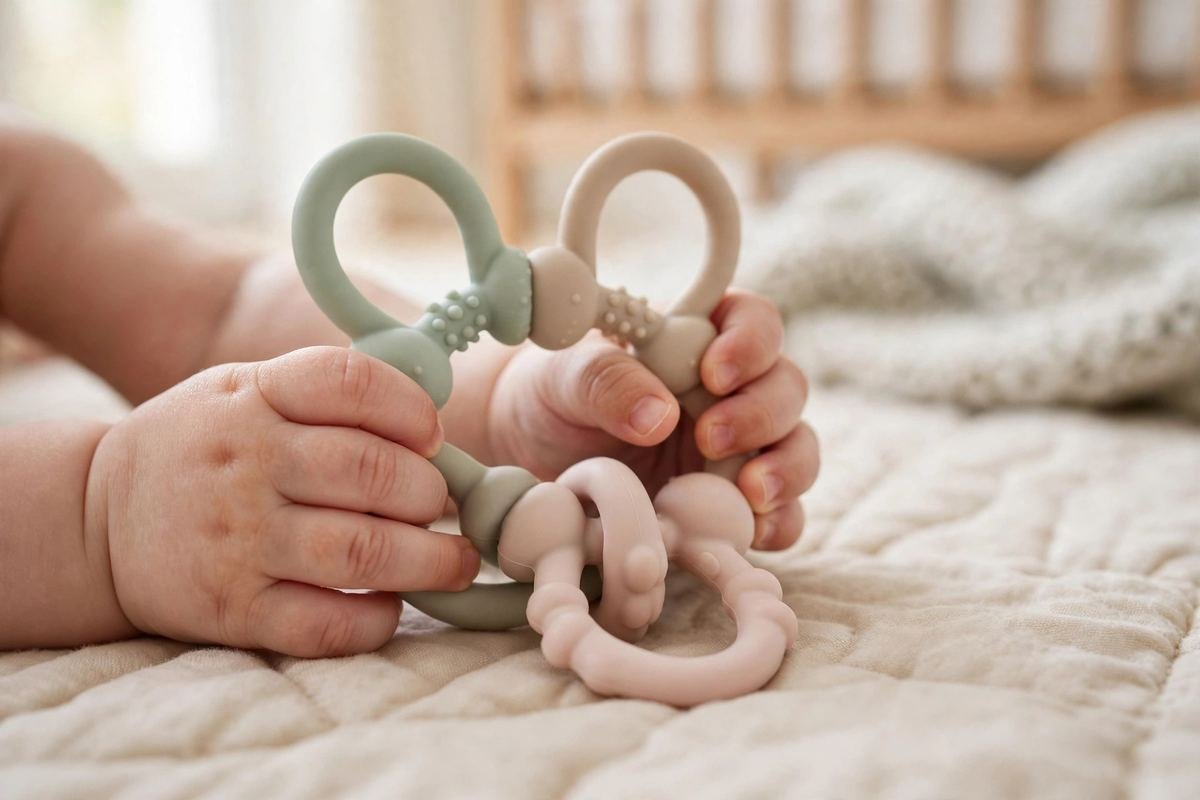
The best grasping toys for babies help tiny hands learn one of life first big skills, holding on. In the early months your baby hands open and close by reflex. Soon, with practice, they reach with purpose, grab a toy, and bring it to their mouth to explore. The right toy makes that practice joyful. It is light, easy to hold, and interesting to look at, shake, and chew.
Easy grasp balls for infants, soft rings, and wooden clutching toys each train the hand in a slightly different way. A good first holding toy fits a small palm, makes a gentle sound, and survives endless drops and washes. The best grasping toys for babies also grow with your child, moving from guided play in your hands to solo play on the mat, in the pram, and in the car.
This guide reviews ten trusted baby grip toys, explains how grasping develops month by month, and shares safety and cleaning advice. For more early play ideas, explore our Newborn and Infant Toys page and our roundup of the best plush toys for babies for soft companions to pair with these picks.
Quick Picks at a Glance
Start here if time is short. The O Ball Classic is the easiest first grasp for most babies, thanks to its open, flexible holes. The Manhattan Toy Skwish is a beautiful wooden choice that older babies enjoy for months. The Haba clutching toys suit parents who love natural materials and fine craft. Every pick below is light, safe, and made for small hands.
- Best overall: O Ball Classic Ball by Bright Starts
- Best wooden: Manhattan Toy Skwish Classic
- Best natural craft: Haba Kringelring Clutching Toy
- Best for sound play: Sassy Wonder Wheel
- Best soft option: Lamaze Freddie the Firefly
How to Choose the Best Grasping Toys for Babies
Weight is the first thing to check. A grasping toy should be light enough for your baby to lift without it landing hard on their face. In the first months, babies wave toys with more energy than control. Soft or hollow designs forgive those happy accidents. As your baby grows stronger, slightly heavier wooden toys become safe and satisfying to hold and shake.
Shape decides how easy a toy is to hold. Open designs with holes, bars, or rings let small fingers hook on from any angle. The famous oball toys for babies work so well because there is no wrong way to grab them. Rings and handles suit the next stage, when your baby reaches with aim. Offering both shapes gives your baby practice at every kind of grip.
Think about sound and texture. A gentle rattle rewards movement and teaches cause and effect. A silent toy suits nap friendly play and travel. Mixed textures, smooth wood, soft fabric, flexible plastic, invite touch and mouthing, which is how babies learn about the world. Infant hand eye coordination toys that combine grip, sound, and texture in one simple design tend to be played with the longest.
Safety and cleaning shape the final choice. For toys that will be mouthed daily, look for trusted brands, smooth finishes, and clear age guidance. Check that paints and finishes are made for baby toys. Plastic toys that rinse clean suit busy days, while wooden toys need a wipe and dry routine. Having two or three grasping rings and balls in rotation means a clean one is always ready while another is in the wash.
Finally, match the toy to the stage. First holding toys 3 months babies enjoy are light and open. From four to six months, babies pass toys between hands and want sound and texture. After six months, they bang, shake, and drop on purpose, so sturdy toys with more to explore earn their place. The best grasping toys for babies meet the stage you are in and still have something to offer next month.
The 10 Best Grasping Toys for Babies
We chose these ten for trusted design, light builds, and the way each one supports the journey from reflex grasp to confident holding, passing, and shaking.
1. O Ball Classic Ball by Bright Starts
The O Ball is the grasping toy parents recommend most, and one play session shows why. The ball is a web of smooth holes, so tiny fingers can grab it from any side. It is light, flexible, and almost silent when dropped. Babies can hold it with two hands, pass it, and later roll and chase it. Among oball toys for babies, the classic remains the standard, and it often becomes the first toy a baby holds alone.
In our best grasping toys for babies guide, this pick earns its spot for an easy grip, safe build, and play that grows with your baby.
- Open hole design is easy to grab from any angle
- Light and flexible for small hands
- Almost silent when dropped
- Rolls for later chasing play
Pros: It is the easiest first success for new graspers.
Cons: The smooth plastic has less texture than fabric toys.
Best for: Babies from two months learning their first grip.
2. Manhattan Toy Skwish Classic
The Skwish is a wooden grasping toy of rods, beads, and strong elastic. Babies can squash it flat and watch it spring back, which never stops being funny. It makes a soft wooden sound when shaken. The finish is smooth and the colours are classic. Parents love that it looks beautiful on a shelf and works hard on the mat. It suits slightly older infants best, once head and arm control are steady.
In our best grasping toys for babies guide, this pick earns its spot for an easy grip, safe build, and play that grows with your baby.
- Squashes flat and springs back into shape
- Smooth wood with a gentle sound
- Supports grasping and two hand play
- Beautiful, lasting design
Pros: It mixes play value with real craft.
Cons: Wood is heavier, so it suits babies from about three months.
Best for: Parents who love wooden toys with a clever twist.
3. Haba Kringelring Clutching Toy
Haba has made wooden baby toys in Germany for generations, and the Kringelring shows that heritage. Two smooth rings move around a central piece, making a soft clacking sound as babies grasp and turn it. The size fits small hands well, and the natural finish feels warm. It is a calm toy for quiet play, and a lovely gift. For families building a small set of soft grasping toys in natural materials, this is a fine anchor piece.
In our best grasping toys for babies guide, this pick earns its spot for an easy grip, safe build, and play that grows with your baby.
- Smooth wooden rings with a soft sound
- Sized for small hands and easy turning
- Natural materials and fine craft
- Calm play without batteries or noise
Pros: It is gentle, natural, and built to last.
Cons: Wooden toys need wiping rather than soaking.
Best for: Parents who prefer natural, quiet toys.
4. Infantino Textured Multi Ball Set
This set of textured balls gives babies several grips to learn in one pack. Each ball has a different surface, bumps, ridges, and soft patterns, and the sizes suit two hand holding. The balls are light, colourful, and easy to wash. Babies enjoy mouthing the textures, and older babies roll and chase them. For infant hand eye coordination toys with variety at a kind price, this set is hard to beat for everyday play.
In our best grasping toys for babies guide, this pick earns its spot for an easy grip, safe build, and play that grows with your baby.
- Several textures in one set
- Light balls sized for two hands
- Easy to wash and quick to dry
- Rolls for crawling practice later
Pros: Variety keeps grasping practice fresh.
Cons: Balls roll away, so play works best in a contained space.
Best for: Babies who love texture and mouthing.
5. Lamaze Freddie the Firefly
Freddie is a soft plush friend packed with graspable parts. Wings crinkle, rings click, and a small mirror hides under one wing. The clip on top fixes Freddie to a pram, car seat, or gym, so the grasping practice travels with you. Babies grab the legs, rings, and wings, each with a different feel. Freddie suits babies who like soft grasping toys with lots to discover in one friendly package.
In our best grasping toys for babies guide, this pick earns its spot for an easy grip, safe build, and play that grows with your baby.
- Crinkle wings, rings, and a hidden mirror
- Clip attaches to prams and car seats
- Many textures and parts to grab
- Soft and light for young babies
Pros: It is a travel toy and a grasping toy in one.
Cons: The busy design may be much for the youngest newborns.
Best for: Babies from three months who enjoy busy toys.
6. Sassy Wonder Wheel
The Wonder Wheel is a grasping and spinning toy with a suction base. It sticks to a highchair tray or table, and babies spin the wheel to watch beads move and hear them cascade. The centre rattle and spinning rings reward batting and grabbing. It shines at the stage when babies sit with support and reach with aim. Parents use it at meal prep time, when a safe and fixed toy keeps little hands happily busy nearby.
In our best grasping toys for babies guide, this pick earns its spot for an easy grip, safe build, and play that grows with your baby.
- Suction base fixes to trays and tables
- Spinning wheel with cascading beads
- Rewards batting, spinning, and grasping
- Great for highchair play
Pros: It stays put, which parents truly value.
Cons: Suction works best on smooth surfaces.
Best for: Sitting babies and highchair play time.
7. Bright Starts Oball Shaker Rattle
This shaker takes the easy grasp O Ball design and adds rattle beads in a clear centre. Babies grab the open sides, shake, and watch the beads move. The sound is cheerful without being harsh. It is light enough for young babies and interesting enough for older ones. As first holding toys 3 months and up go, this is a joyful step up from a silent ball, and it costs little for the smiles it brings.
In our best grasping toys for babies guide, this pick earns its spot for an easy grip, safe build, and play that grows with your baby.
- Easy grasp open design with rattle beads
- Clear centre shows the moving beads
- Light for young babies
- Cheerful and gentle sound
Pros: It adds sound to the easiest grip in baby toys.
Cons: The rattle sound carries in quiet places like planes.
Best for: Babies ready to move from silent toys to sound.
8. Manhattan Toy Whoozit
The Whoozit is a soft, friendly face with arms, legs, and hidden rattles and squeaks in its parts. Every limb is a different shape to grab, and the bold face draws babies in. It clips and hangs well, and it is soft enough for face level play. Babies find a new sound or texture each week as their grip improves. It is a charming choice among baby grip toys for families who like soft toys with character.
In our best grasping toys for babies guide, this pick earns its spot for an easy grip, safe build, and play that grows with your baby.
- Soft body with many grabbable limbs
- Hidden rattles and squeaks to discover
- Bold face babies love to study
- Light and safe for close play
Pros: Every grab gives a new surprise.
Cons: The many parts take longer to clean well.
Best for: Babies who enjoy soft, characterful toys.
9. Infantino Spin and Shake Pal
This pal combines rings, beads, and a spinning centre in a light grasping toy. Babies hold the handles, shake for sound, and spin the middle to watch colours move. The size suits two hand play, and the build is sturdy for daily drops. It is a fine choice for the stage when babies pass toys hand to hand and test them with a good bang on the floor. Simple, sturdy, and cheerful, it earns its place here.
In our best grasping toys for babies guide, this pick earns its spot for an easy grip, safe build, and play that grows with your baby.
- Handles sized for two hand holding
- Spinning centre with moving beads
- Sturdy build for daily drops
- Sound and motion in one toy
Pros: It supports the passing and banging stage well.
Cons: It is bigger than the lightest first toys.
Best for: Babies from four to six months building skills.
10. Grapat and Grimm Style Wooden Grasping Beads
Wooden grasping beads, strung on strong cord in rainbow or natural tones, are a Montessori inspired classic. Babies grasp the beads, slide them, and listen to their soft knock. The natural wood warms in the hand and the simple design invites focus. These toys suit parents who value open ended play and natural materials. Choose a trusted maker, check the cord and finish, and you have a toy that can be kept and handed down.
In our best grasping toys for babies guide, this pick earns its spot for an easy grip, safe build, and play that grows with your baby.
- Natural wooden beads on strong cord
- Sliding beads reward grip and movement
- Soft natural sound
- Open ended, lasting design
Pros: It is calm, natural, and beautiful to keep.
Cons: Parents must check cord toys often for wear.
Best for: Montessori minded families and gift givers.
Safety and Care Tips for Grasping Toys
Check grasping toys often, because they live in mouths and take daily drops. Look for cracks, loose beads, worn cords, and peeling finishes. The United States Consumer Product Safety Commission offers toy safety guidance for parents at CPSC.gov. Remove any toy that breaks, and follow the age guidance on the pack, since small parts suit only older babies.
Wash plastic toys with warm soapy water and let them dry fully. Wipe wooden toys with a damp cloth and dry them at once, so the wood stays smooth. Wash fabric parts as the label allows. A simple weekly clean keeps mouthing toys fresh. Store the clean set in a small basket your baby can reach, and read our tips on baby toy storage for simple ways to rotate toys and keep play feeling new.
Offer grasping toys during calm, awake times on the floor. Place one toy just within reach and let your baby work for it. Short, happy sessions beat long ones, and your smile and voice are the best encouragement of all. As skills grow, offer two toys and watch the lovely moment when your baby chooses one and passes it between their hands.
Frequently Asked Questions
When do babies start grasping toys?
Most babies begin reaching and swiping at toys around two to three months, and grasp with purpose by three to four months. At first the grip is a reflex, then it becomes a choice. Light toys with open designs help babies succeed early. The best grasping toys for babies match this stage with easy holds and gentle sounds.
How do grasping toys help development?
Grasping builds hand strength, finger control, and hand eye coordination. Passing a toy between hands links both sides of the body and brain. Mouthing a safe toy teaches shape and texture. These small skills lead to holding a spoon, turning pages, and self feeding later in the first year and beyond.
Are wooden grasping toys better than plastic?
Both have strengths. Wood feels warm, lasts for years, and often has a gentle sound. Plastic can be lighter, brighter, and easier to wash, and open designs like the O Ball are unmatched for first grips. Many parents keep a mix, offering wood for calm play and light plastic for young or sleepy babies.
How many grasping toys does my baby need?
Three to five is plenty. A ball, a ring, a rattle, and a soft toy cover the main grips and sounds. Rotating toys every few days keeps interest high without buying more. Borrow or swap with friends if you can, and add a new shape only when you see a skill that needs a fresh challenge.
What if my baby keeps dropping the toy?
Dropping is learning. Babies drop to test gravity, sound, and your response, and each retrieval is practice too. Choose light toys that are safe to drop, play on a soft mat, and keep sessions short and cheerful. With weeks of practice, the grip grows stronger and the drops turn into throws with aim.
Conclusion
The best grasping toys for babies are light, safe, and easy to love. The O Ball leads for the easiest first grip, the Skwish leads for wooden craft and bounce back fun, and the Haba clutching toy leads for calm natural play. Start with one or two, watch how your baby plays, and add shapes as skills grow. For more first year guides, visit our homepage and browse the latest posts on our blog.
