
Three is the age of questions, plans and proudly announced projects. Preschoolers sort, count, build, thread and pretend with real purpose, and montessori toys for 3 year olds are designed to keep up. The materials at this stage grow more layered: early maths with real quantities, letters met through the fingers, games with simple rules, and tools that demand genuine skill. A good shelf now supports longer projects, early friendships and the deep satisfaction of finishing something independently.
The best montessori toys for preschoolers share the classic Montessori traits: natural materials, one clear purpose per activity, and feedback built into the material itself. But they also stretch further than toddler toys. Parents looking for montessori toys for 3 year olds usually want materials that prepare a child for preschool or school: counting, patterning, letter sounds, handwriting strength and the patience to follow steps in order. Every pick below earns its place on those terms.
You will find early maths materials, language starters, fine motor challenges and one beloved cooperative game. Many of these are genuine montessori classroom toys for 3 year olds, adapted for home shelves by makers like PlanToys, Melissa and Doug, Haba and Lovevery. If you are choosing a montessori gift for 3 year old birthdays, the balancing cactus and the beehives are the two gifts that adults end up playing with long after the children are in bed.
Quick Picks: Our Favourite Montessori Toys for 3 Year Olds
In a hurry? These five picks cover maths, language, fine motor skill, balance and first board game play. Each is a strong example of montessori toys for 3 year olds that preschools also trust, and the full list below adds five more for counting, spelling and careful hand work.
- Best play kit: Lovevery The Free Spirit Play Kit
- Best balance game: PlanToys Balancing Cactus
- Best for early reading: Melissa and Doug See and Spell
- Best early maths: PlanToys Sort and Count Cups
- Best first game: Haba First Orchard
How to Choose Montessori Toys for 3 Year Olds
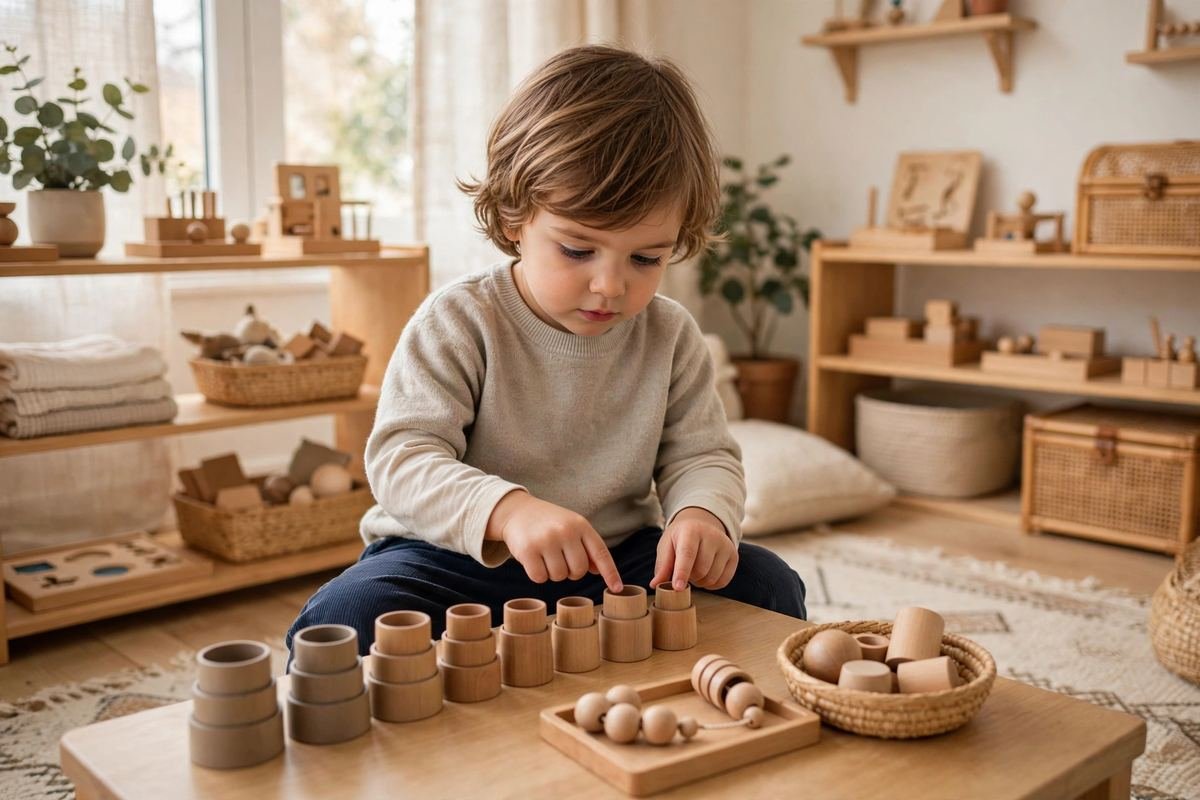
At three, children learn in longer arcs. They return to the same material for days, adding their own variations, which is exactly what montessori learning materials for preschool shelves are designed to allow. Before buying, check the material against the three ideas below. They will help you choose educational montessori toys for kids that teach something real, rather than bright boxes that promise school readiness and deliver a week of novelty.
Look for Real Early Academics
Montessori introduces maths and language through the hands. Quantities come before numerals, sounds come before letter names, and patterns come before worksheets. Montessori toys for 36 month olds should follow that order: counting objects a child can touch, puzzles that link a numeral to a real amount, and letters traced by fingers. Avoid materials that drill with flashing right and wrong lights; the material itself should show the answer quietly and clearly.
Choose Materials That Support Independent Play
Three year olds flourish when they can choose work, carry it to a mat, complete it and put it away alone. Montessori toys for independent play are self contained, stored on trays or in boxes, and include everything needed in one place. Check that your child can open the box, understand the goal from the pieces, and tidy it without help. Independence at this level builds the concentration and confidence that teachers notice in the first weeks of school.
Keep Fine Motor Work in the Mix
Writing muscles are built long before pencils. Threading, lacing, tweezing, screwing and balancing all strengthen the small muscles of the hand and the coordination between hand and eye. Keep at least two fine motor materials on the shelf and rotate them as the skill grows. Our guide to learning toys for babies and toddlers explains how these hand skills develop step by step from the first year onward.
The 10 Best Montessori Toys for 3 Year Olds Reviewed
1. Lovevery The Free Spirit Play Kit
The Free Spirit Play Kit is Lovevery’s set for months 34, 35 and 36, right at the doorway to preschool. Inside are playthings for early maths and patterns, a threading and lacing challenge, imaginative play pieces and a book that supports the feelings talk of this stage. The design is calm, the materials are wood, cotton and safe finishes, and every item has one clear job. For parents who want montessori toys for 3 year olds curated by stage, it remains the simplest complete answer.
- Stage based playthings for months 34 to 36
- Early maths, patterns and threading included
- FSC wood, organic cotton and safe finishes
- Parent guide with observation tips
Pros: The progression is thoughtful, the quality is high, and the kit balances academic starters with emotional play. Cons: The subscription and price are significant, and confident preschoolers may finish some pieces quickly. It suits families entering preschool who want a ready made shelf that covers maths, language readiness and feelings in one considered box.
2. PlanToys Balancing Cactus
The Balancing Cactus is a game of nerve disguised as a toy. Players take turns adding coloured cactus pieces to a central trunk, choosing slots and judging balance as the plant grows wobblier. One careless move and the whole cactus tumbles, to general delight. It teaches early physics, patience and turn taking with zero reading required. The pieces are rubberwood, the colours are gentle, and the game works just as well solo as it does with the whole family.
- Thirteen cactus pieces plus the base trunk
- Teaches balance, planning and steady hands
- Solo or group play for one to four players
- Made from sustainable rubberwood
Pros: It is genuinely fun for adults too, the rounds are short, and the skill ceiling rises with the child. Cons: Pieces roll when the cactus falls, and younger three year olds need a patient partner at first. It suits families who play together daily, and it is one of the most requested montessori toys for 3 year olds as a birthday gift that avoids plastic clutter.
3. Melissa and Doug See and Spell
See and Spell introduces reading the Montessori way, through building words by hand. The wooden box holds letter tiles and two sided puzzle boards with friendly pictures and three or four letter words to complete: cat, pig, bus, sun and more. Children place the letters into the cut out spaces, saying the sounds as they go. The boards give just enough support that a beginner succeeds, while the free letters invite experimenting with names and invented words later.
- Fifty plus wooden letters and eight two sided boards
- Sixteen simple words to build and read
- Cut out spaces guide correct letter placement
- Storage box keeps letters contained
Pros: It links letters, sounds and words physically, and the self guiding boards build confidence fast. Cons: It covers short words only, and lost letters limit the word list, so keep the box closed between uses. It suits preschoolers who are starting to ask what words say, and parents who want reading readiness materials that feel like play rather than lessons.
4. PlanToys Sort and Count Cups
This simple set does serious maths work. Five wooden cups in five colours come with ten small counters, and the play unfolds in stages: sort the counters by colour, count them into cups, match quantities, then start simple adding with real objects. The materials are honest and beautiful, made from rubberwood with organic pigments. Because the set is open ended, it also becomes pretend food, treasure and shop stock, which keeps it on the shelf long after the counting games are mastered.
- Five coloured cups and ten wooden counters
- Sorting, counting and early adding in one set
- Supports one to one correspondence practice
- Open ended pieces double as pretend play food
Pros: It teaches the real foundation of number sense, quantity, before any worksheet appears. Cons: Ten counters is a small set, and the small pieces need supervision around younger siblings. It suits methodical little mathematicians, and it is a faithful home version of the counting work found in montessori toys for 3 year olds used in real classrooms.
5. Melissa and Doug Pattern Blocks and Boards
Pattern blocks are a quiet giant of early geometry. This set includes one hundred and twenty small wooden shapes, triangles, squares, diamonds and hexagons, plus five two sided boards with picture outlines to fill. Children match shapes to the outlines, rotate pieces to fit, and later design their own patterns freely on the table. The work builds spatial reasoning, shape knowledge and the earliest feel for symmetry and fractions, all without a single number being mentioned.
- One hundred and twenty wooden pattern blocks
- Five two sided boards with ten designs
- Builds geometry, rotation and symmetry skills
- Free play designs extend the challenge
Pros: The difficulty grows smoothly from matching to free design, and group play works beautifully. Cons: The pieces are small and numerous, so tidying needs a system, and the boards are best for the older end of this age group. It suits visual thinkers and puzzle lovers, and it pairs well with a simple toy storage tray so the set stays complete and inviting on the shelf.
6. Haba My Very First Games: First Orchard
First Orchard is the cooperative board game that Montessori families recommend again and again. Players roll a chunky die and work together to pick the fruit from the trees before the raven reaches the orchard. Everyone wins or loses together, which spares three year olds the sting of defeat while they learn rules, turns and colours. The wooden fruit pieces are gorgeous, the die is oversized for small hands, and a full game takes about ten happy minutes.
- Cooperative play with no individual losers
- Chunky wooden fruit and a large colour die
- Teaches rules, turns and colour matching
- Short rounds suit preschool attention spans
Pros: It introduces board game manners gently, and the wooden pieces survive years of play. Cons: The fruit pieces are tempting to mouth, and the game is simple for older five year olds. It suits families who want a first game night ritual, and it sits naturally among montessori toys for 3 year olds because cooperation, not competition, drives the whole design.
7. PlanToys Beehives
Beehives is a fine motor workout dressed as a honey farm. Six coloured beehives come with six matching bees, and children use the wooden forceps to pick up each bee and place it in its hive. The grip needed is exactly the grip that later holds a pencil. Children also sort by colour, count the bees and invent counting games. The forceps are well sprung for small hands, and the hives stack and store neatly when the work is done.
- Six beehives and six colour matched bees
- Wooden forceps build the pencil grip
- Colour sorting and counting built in
- Made from sustainable rubberwood
Pros: The hand strengthening is real and measurable over weeks, and the bee theme delights preschoolers. Cons: The bees are small, so this is strictly for supervised play at three, and weak forceps skills frustrate at first. It suits children who love careful, fiddly work, and teachers put it high on lists of montessori toys for 3 year olds for good reason.
8. Melissa and Doug Classic Wooden Abacus
The classic abacus earns its name. Ten rows of ten beads in bright colours slide on a sturdy wooden frame that stands firm on a table or floor. Three year olds start by sliding and counting beads by colour, then count to ten, twenty and beyond, and eventually see tens and simple sums as physical facts. There are no batteries, no sounds and no gimmicks, just quantity made visible. The frame is solid, the beads are smooth, and it looks handsome on a shelf.
- One hundred beads on ten sturdy rows
- Counting, colour grouping and early sums
- Solid wooden frame stands firmly
- Supports the concrete maths Montessori values
Pros: It makes number bonds and place value tangible years before formal maths, and it lasts for every sibling. Cons: It is a single purpose material, so pair it with open ended play elsewhere on the shelf. It suits number curious preschoolers and parents who want early maths rooted in real quantities rather than screen based drills.
9. Tegu 24 Piece Magnetic Wooden Block Set
The twenty four piece Tegu set takes magnetic building to preschool scale. Cubes, columns, planks and parallelograms, each with hidden magnets, click together into houses, cars, animals and towers that hold their shape. The bigger piece count allows real projects, and the set comes in a felt pouch that keeps it together. Tegu uses sustainably sourced hardwood and safe finishes, and the blocks feel wonderful in the hand compared with hollow plastic alternatives.
- Twenty four magnetic blocks in four shapes
- Hidden magnets allow building in all directions
- Sustainably sourced hardwood with safe finish
- Felt storage pouch included
Pros: Structures survive being carried across the room, which encourages longer building projects and storytelling. Cons: The price is premium, and twenty four pieces still run out on ambitious castle days. It suits builders who have outgrown simple stacking, and it is a generous gift choice for families who value beautiful, durable materials over quantity.
10. Melissa and Doug Lacing Beads in a Box
Lacing beads are pure hand gym. This box holds twenty seven chunky wooden beads in shapes like stars, hearts and barrels, plus two laces with wooden tips. Children thread patterns by colour and shape, make necklaces, and compare lengths. The tip on each lace is long and firm, so threading succeeds without fraying frustration. The work builds bilateral coordination, patience and sequencing, and the finished strings give three year olds a product they can proudly show and gift.
- Twenty seven beads in varied shapes and colours
- Two laces with firm wooden tips
- Patterning, sequencing and hand strength
- Boxed set stores neatly on the shelf
Pros: It is quiet, portable and endlessly repeatable, with skill growth you can watch week by week. Cons: Laces tangle if thrown in a toy box, so store them coiled in the box, and beads need counting back in. It suits patient, crafty preschoolers and long car journeys, and it remains one of the most practical montessori toys for 3 year olds for building writing readiness.
Safety and Care
Montessori toys for 3 year olds include smaller parts than toddler toys, beads, counters and letter tiles, so match the material to your child’s habits. If your preschooler still mouths objects, keep small piece sets for supervised table work and store them out of reach afterwards. Check wooden pieces for cracks and splinters, and retire anything damaged. The American Academy of Pediatrics offers clear choking hazard guidance for parents at HealthyChildren.org.
Keep sets complete, because a counting set missing counters quietly teaches the wrong lesson. Count pieces back into their boxes with your child as part of the activity, which reinforces maths and care at once. Wipe wooden materials with a damp cloth, dry them fully, and store trays and boxes where your child can reach them safely. A cared for shelf signals respect for the work, and children rise to meet that signal.
Frequently Asked Questions
What should a 3 year old learn from Montessori toys?
The focus at three is foundations: counting with real quantities, recognising patterns, hearing letter sounds, building hand strength and working independently. Montessori toys for 3 year olds are picked to grow these exact skills through play that feels self chosen. You should see longer concentration, more careful hand movements and early number and letter confidence appearing naturally across a few months of regular shelf work.
Are Montessori classroom materials too serious for home?
Not at all. Classroom materials look plain because the interest is built into the work, not the packaging. At home, present one material at a time on a tray, show it slowly once, then let your child explore. Children treat these materials with surprising respect when adults present them that way. The calm look also keeps living rooms feeling like homes rather than toy shops.
How do I introduce letters the Montessori way?
Start with sounds, not letter names. Choose a few letters your child hears at the start of familiar words, trace the shape with two fingers while saying the sound, and play simple matching games. Building short words with tiles, as in the See and Spell set, comes after sound play. Keep sessions short and cheerful, and stop while it is still fun, so reading stays linked with pleasure.
How many toys should a 3 year old have?
A shelf of eight to twelve activities suits most three year olds, with a balance of maths, language, fine motor work, building and pretend play. Quality matters far more than quantity at this stage. One complete, cared for set of montessori toys for 3 year olds will teach more than a mountain of novelty toys, because repetition and completion are where the learning lives.
What is a good Montessori birthday gift for a 3 year old?
The Balancing Cactus, Beehives and First Orchard are the safest bets: beautiful, social and used weekly in most homes. If the child loves numbers, choose the abacus or counting cups. If they are crafty, lacing beads travel anywhere. A single well chosen material, presented in its box with care, makes a gift that parents quietly thank you for at every tidy shelf.
Conclusion
The best montessori toys for 3 year olds treat preschoolers as capable learners with real work to do. Counting cups make quantity visible, letter tiles make words touchable, and balancing games make physics a family sport. Choose a few materials that match the skills you see emerging, keep them complete and cared for, and let your child return to them until mastery arrives. Explore our full educational and learning toys range for the stages ahead, and enjoy watching independence grow, one tray of work at a time.
