
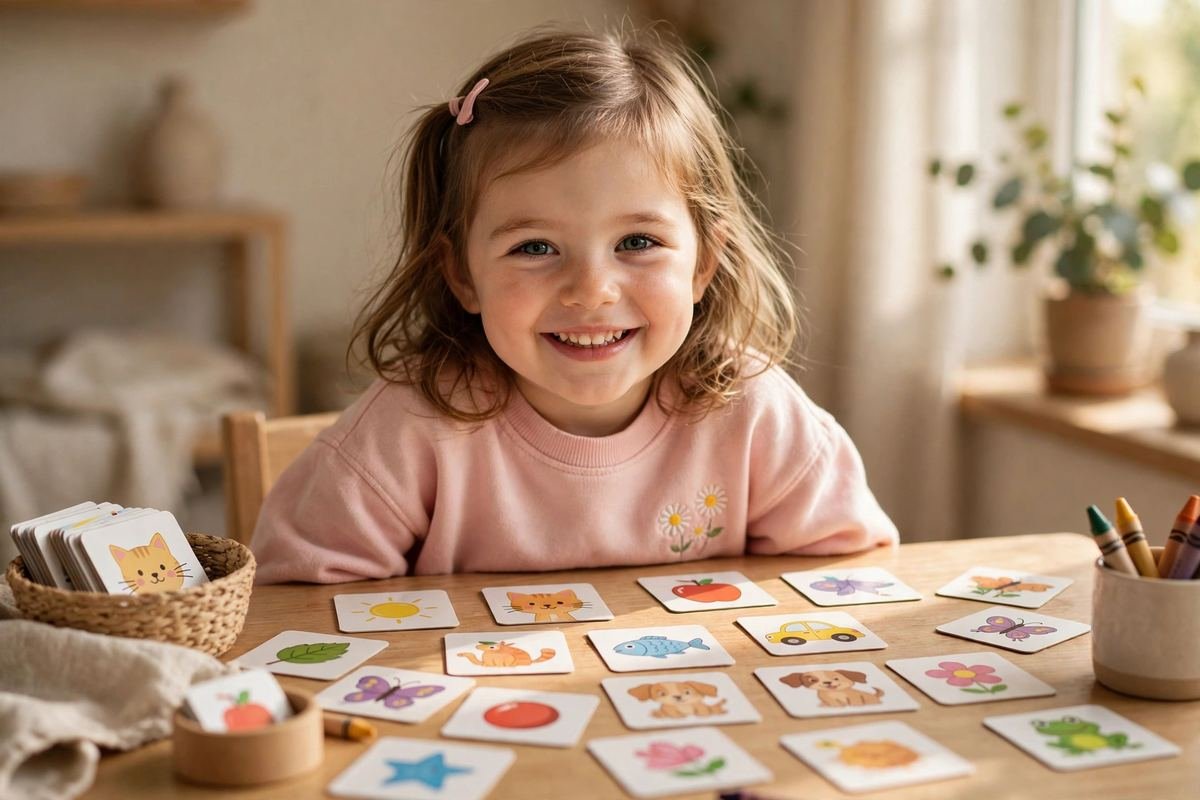
Turning over two cards and finding a matching pair looks simple, yet it asks a young child to remember, focus, wait and try again. The best memory games for preschoolers build those early skills through cheerful pictures and short, satisfying turns. They also give families a calm game that needs no screens and very little setup. You can browse more ideas in our educational and learning toys collection.
Good memory games for preschoolers grow with your child. You can start with just six or eight cards face up, then add more pairs and turn them face down as confidence grows. Short rounds keep success within reach, while familiar animals, foods and vehicles give children plenty to talk about. That talking matters, because naming pictures builds vocabulary as well as recall and patience.
Many families begin with the best matching games for toddlers because the rules are easy to show rather than explain. A child turns a card, looks for its partner and learns from every near miss. These concentration games for preschoolers also teach gentle social skills, such as taking turns, coping with disappointment and celebrating when another player finds a pair.
Quick Picks
If you are short on time, start with these five dependable favourites. Each one suits a slightly different child, from a first simple matching game to a story rich board game for older preschoolers.
- Ravensburger My First Memory: a gentle first game with large, clear picture cards
- Orchard Toys Shopping List: a much loved lotto style game with everyday vocabulary
- eeBoo Life on Earth Memory and Matching Game: beautiful nature art for curious children
- HABA Animal Upon Animal Memory Game: playful animal fun from a trusted maker
- Wonder Forge Marvel Matching Game: familiar heroes for children who love characters
How to Choose Memory Games for Preschoolers That Fit Your Child
Start with your child rather than the box. The right memory games for preschoolers match their current attention span, interests and hand skills, with room to grow. A game that feels a little challenging will hold interest, while one with too many cards can lead to wandering attention and mixed up pieces. The guide below will help you choose with confidence.
Start With Age, Attention and Card Count
For a two or three year old, begin with four to six pairs and play with the cards face up. Most memory card games for 3 year olds work best when an adult plays alongside, modelling how to turn one card at a time. Add pairs slowly, and stop while your child is still enjoying the game. Ending on a happy note makes them keen to play again tomorrow.
Choose Pictures, Themes and Ways to Play
Clear pictures with strong colours are easier for young children to tell apart than busy scenes. Picture matching games for kids work especially well when the images link to daily life, such as foods, animals, clothing or vehicles. A theme your child already loves will hold attention far longer than a clever theme chosen only by an adult.
Families who like calm, child led play often enjoy montessori memory games, which favour natural themes, simple rules and quiet concentration. Other children prefer cooperative games where everyone works together, or gentle competitive games where finding the most pairs wins. There is no single right style, so follow the mood your child brings to the table.
Think About Home, Travel and Storage
Consider where the game will live and be played. Sturdy cards survive enthusiastic handling, and a compact box is easier to store and carry. Travel memory games for toddlers are handy for restaurants, trains and waiting rooms, provided the set has few pieces to lose. Families choosing their first board games for memory should also look at our guide to baby learning toys for more play ideas.
The Best Memory Games for Preschoolers for Focus and Fun
Each pick below is a real game from a well known maker, chosen for clear pictures, simple rules and lasting play value. Read the notes on who each game suits to find the best fit for your child.
1. Ravensburger My First Memory Game
Ravensburger has made memory games for decades, and this first version keeps everything simple for very young players. Large cards show friendly animals that are easy to name and recognise, and the set can be reduced to just a few pairs for a first try. Children practise remembering where each animal hides while adults can talk about colours, sounds and habitats. The sturdy card and calm pace make it a reassuring introduction to playing games together at the table.
- Large picture cards made for little hands to hold
- Friendly animal pictures that invite naming and talk
- Flexible pair count for very short first games
- Simple rules an adult can teach in minutes
Pros: trusted maker, clear artwork and a gentle learning curve. Cons: older preschoolers may want more pairs and a bigger challenge. It suits toddlers and younger preschoolers who are ready for a first matching game and enjoy animal pictures, short turns and playing side by side with a parent or grandparent.
2. Orchard Toys Shopping List Game
Orchard Toys Shopping List is a British classic that blends memory with everyday learning. Each player has a trolley board and a shopping list, then turns over cards to find the foods and household items they need. Children must remember where the cheese or socks were seen while building useful vocabulary. Because everyone can see their own list, the game feels friendly rather than pressured, and the familiar supermarket theme sparks plenty of chat about real shopping trips.
- Shopping list boards give every player a clear goal
- Everyday items build practical vocabulary through play
- Chunky cards suit preschool hands and repeated use
- Booster packs are available to refresh the game
Pros: educational, social and easy for new players to join. Cons: the luck of the draw can frustrate a child who keeps missing one item. It suits families searching for memory games for preschoolers that teach daily words while keeping turns quick, cheerful and easy to follow.
3. eeBoo Life on Earth Memory and Matching Game
eeBoo is known for beautiful illustration, and Life on Earth brings plants, animals and natural scenes to the matching table. The artwork gives children something genuinely lovely to look at while they search for pairs, and each picture opens a small conversation about the natural world. Parents can begin with a handful of pairs and build up to the full set as memory improves. It is a calm, screen free game that feels as enriching as it is fun.
- Rich nature artwork by a well regarded illustrator
- Sturdy tiles with a smooth, pleasant finish
- Plenty of pairs for growing memory skills
- Compact box that stores neatly on a shelf
Pros: gorgeous pictures and strong conversation value for curious minds. Cons: detailed artwork can be harder for the youngest toddlers to tell apart. It suits nature loving preschoolers who enjoy animals and plants, and families who want a matching game that still feels fresh after many plays.
4. HABA Animal Upon Animal Memory Game
HABA brings its playful animal world to a memory format that young children find hard to resist. Players look for matching animals among the cards, with the charming artwork and bright colours keeping attention on the table. HABA designs games in Germany with young children in mind, so the rules stay short and the pieces feel solid. This is a lovely choice when you want a game that siblings of slightly different ages can enjoy together without long explanations.
- Cheerful animal artwork in the classic HABA style
- Short rules that young children grasp quickly
- Solid components made for family play
- Works well with mixed age sibling groups
Pros: durable, charming and welcoming for first time players. Cons: availability can vary by country and stock changes often. It suits families who want memory games for preschoolers with a playful European feel, friendly animals and rounds short enough for busy evenings. It also works well as a bridge toward slightly longer family games later on.
5. Wonder Forge Disney Princess Matching Game
Wonder Forge makes licensed matching games featuring characters children already know and love, and the Disney Princess edition is a favourite example. Familiar faces give hesitant players an instant reason to join in, because spotting a beloved character feels exciting even before a pair is found. The format follows the classic turn and match pattern, so adults who played matching games as children will feel at home straight away. It is an easy gift choice for character loving families.
- Beloved characters motivate reluctant first players
- Classic matching format with no reading required
- Portable card set for play at home or away
- Large character selection keeps rounds interesting
Pros: instant appeal for princess fans and very simple setup. Cons: children who are not interested in the theme will prefer a neutral set. It suits preschoolers who light up at familiar characters and families who want a friendly, familiar game for birthdays, holidays and quiet afternoons.
6. Hasbro Matching Game
The classic Hasbro matching format has introduced generations of children to memory play. Players turn over tiles or cards two at a time, trying to remember positions and collect pairs, and the player with the most pairs at the end wins. Editions vary by theme and region, so check the pictures on the box before buying. The simple structure makes it easy to shorten a game, lend it to friends or play a quick round before dinner.
- Timeless rules almost every adult already knows
- Easy to shorten by removing some pairs
- No reading needed, so language is no barrier
- Widely available in many themed editions
Pros: familiar, flexible and simple enough for grandparents to lead. Cons: themes and card quality vary between editions, so inspect before buying. It suits families who want memory games for preschoolers in the classic style, with clear turns, gentle competition and a format that grows from a few pairs to a full table.
7. Briarpatch I Spy Memory Game
Briarpatch builds its I Spy games around the popular books by Jean Marzollo and Walter Wick, where children hunt for hidden objects in rich photographic scenes. This memory version asks players to remember and match objects from those busy, beautiful pictures. It rewards careful looking as much as recall, which helps children slow down and really observe. Older preschoolers especially enjoy the sense of detective work, and adults often find the searching just as absorbing as the children do.
- Based on the much loved I Spy picture books
- Photographic scenes reward careful looking and focus
- Memory and observation skills grow together
- Appeals to older preschoolers who want more challenge
Pros: visually rich and more challenging than basic pair games. Cons: busy scenes may overwhelm younger toddlers at first. It suits observant preschoolers who enjoy puzzles and hidden picture books, and families looking for a step up once simple matching feels too easy.
8. Orchard Toys Smelly Wellies Game
Smelly Wellies is a giggly Orchard Toys matching game where players race to fill their welly boards with matching pairs of colourful boots. Each pair has a fun pattern and a silly picture, from spotty boots to boots with frogs, which gives children strong visual clues to remember. The humour keeps the mood light when a turn goes wrong, and the board format helps younger players see how close they are to finishing. It is cheerful, sturdy and very British in spirit.
- Silly welly designs give strong memory clues
- Boards show progress and keep players motivated
- Sturdy pieces designed for preschool play
- Humour softens the sting of a missed pair
Pros: funny, friendly and easier to follow than open card grids. Cons: the board format offers less pure memory challenge than classic cards. It suits families who want memory games for preschoolers that feel light and silly, especially for children who play best when laughter matters more than winning.
9. Peaceable Kingdom Where’s Bear? Game
Peaceable Kingdom specialises in cooperative games, and Where’s Bear? combines stacking, hiding and memory in one gentle package. Children hide the bear under boxes and try to remember where he is, answering simple questions and working together rather than competing. The cooperative style removes the pressure of winning and losing, which helps sensitive children relax and join in. Short rounds and sweet illustrations make it a calming choice for play before bed or quiet time at home.
- Cooperative play with no winners or losers
- Hiding and seeking adds active memory fun
- Simple questions build language and reasoning
- Gentle pace suits calm, quiet play sessions
Pros: kind, cooperative and ideal for children who dislike losing. Cons: confident older preschoolers may outgrow the simple format sooner. It suits toddlers and younger preschoolers who thrive on teamwork, hiding games and unhurried play with a caring adult close by. The sweet bear theme and simple hiding idea feel familiar and comforting to very young children right from the first round.
10. Ravensburger Enchanted Forest Game
Enchanted Forest is a classic Ravensburger board game that turns memory into a treasure hunt through a fairytale woodland. Players roll and move around the board, lift trees to peek at the treasure hidden beneath, then race to report what they remember when they reach the castle. Remembering which tree hides which treasure is the heart of the game. It suits older preschoolers who are ready for a longer game with a board, a journey and a little more thinking.
- Board game journey built around remembering hidden treasures
- Fairytale theme sparks imagination and storytelling
- Encourages planning as well as simple recall
- A long loved classic from a trusted maker
Pros: rich theme and a real step up in challenge and length. Cons: longer play time needs a child ready to stay at the table. It suits families seeking memory games for preschoolers who have mastered card matching and are ready for a first story led board game adventure.
Safety and Care
Choose games with age guidance that matches your child, and check cards and tiles for damage before play. Well made memory games for preschoolers use thick card that resists bending and chewing, but pieces should still be kept away from babies who mouth everything. The American Academy of Pediatrics offers helpful guidance on choosing safe, suitable toys through HealthyChildren.org, the parenting site of the AAP.
Supervise early games, count pieces back into the box together, and treat tidying up as part of the routine. Storing sets in a labelled box or drawer keeps pairs complete and ready for the next game. Our notes on baby toy storage share simple ways to keep small game pieces organised, visible and out of reach of younger siblings.
Frequently Asked Questions
At what age can children start playing memory games?
Many children can enjoy simple matching from around age two, starting with a few pairs placed face up. Memory games for preschoolers become true memory play closer to age three, when children can hold a picture in mind and take turns. Follow your child rather than the box, and keep early sessions short, warm and full of praise for effort.
How many cards should a first game have?
Begin with four to six pairs and add more only when your child finds pairs with ease. A small set keeps rounds short and success frequent, which protects confidence. As recall improves, add two pairs at a time. If frustration appears, quietly remove a few pairs again. The game should always feel like play, never like a test.
Are memory games good for learning and development?
Yes, when they are playful and well matched to the child. Memory games for preschoolers practise working memory, concentration, language and turn taking in a natural way. Naming pictures builds vocabulary, and remembering positions supports early maths and reading readiness. Short, regular play with an engaged adult brings the biggest benefit, because conversation around the game matters as much as the cards.
What if my child gets upset when they lose a turn?
This is very common and part of learning. Keep your tone light, name the feeling and show how you handle a missed pair yourself. Cooperative games can help sensitive children build confidence before gentle competition. Shortening the game also helps, because tired children cope less well. Over time, most children learn that a missed turn is only a small moment in a fun game.
Can we make our own memory game at home?
Absolutely. Draw or print two copies of simple pictures, such as animals, fruits or family faces, on thick card. Start with four pairs and let your child help colour them, which adds pride and interest. Homemade sets are a lovely low cost way to try the format before buying, and children often treasure a game they helped to create.
Conclusion
The right game turns a few quiet minutes into real learning, laughter and connection. Whether you choose a classic card set, a cooperative hiding game or a fairytale board game, memory games for preschoolers reward patience and practise in the gentlest way. Start small, play often and let your child lead the pace. With a good match for their age and interests, memory play can become a treasured part of your family routine.
